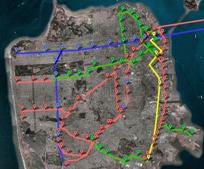
What would a San Francisco subway system look like? Maybe a little something like this…

Thumbnail of a proposed comprehensive subway system for San Francisco

I’m a big fan of Eric’s Transbay Blog. This Eric fellow never fails to impress.

A recent post posed this question: if we had all the money in the world to spend on transit (and sometimes it seems like we do) what would a comprehensive City subway system look like?

Link

Posted in transit | Tagged , , , , , , , , , , , , , , , , | Leave a comment

More proof that Microsoft hates Apple: Office on Mac OS X sucks.

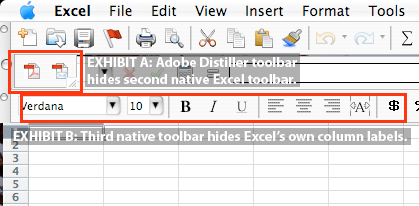
Excel on Mac OS X sucks (thumbnail)

Microsoft Office for Mac OS X sucks. Everyone knows it.

Let’s count the ways:

  • It’s a system resource hog. Loading Microsoft Word takes forever. Look MS, this is a friggin’ rich text editor. You don’t need to load the entire Visual Basic for Applications runtime library in order for me to write a letter to my grandma.
  • Entourage. It was supposed to be the Mac version of Outlook. Unfortunately, it’s more like Outlook’s bastard child which MS kept locked in the closet to starve. Entourage barely accomplishes its core task of being a Mac OS X Exchange client. Avoid at all costs.
  • Excel for OS X isn’t as bad as Entourage, but it is a significant downgrade from the PC version. In addition to ridiculous unusable default placement of GUI elements (here’s the full version of the above thumbnail), other interface elements are simply alien. Instead of pressing F2 to edit a cell, you press Ctrl+U.
  • Ctrl+U? Who in the hell invented this shit? Perhaps the Office for Mac team was sequestered on the moon during development and was only fed rice krispies, 7UP and crack.

Let’s hope the next update, Microsoft Office for Mac 2008, doesn’t suck.

Posted in tech | Tagged , , , , , , , , , , , , , , , , , , , , , | 20 Comments

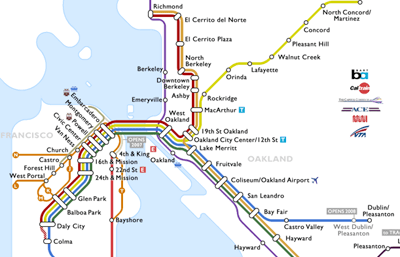
We need more useful transit maps in the Bay Area. Here are a few.

Bay Area Rail Map (thumbnail)

Most transit maps of Bay Area and City transit systems suck.

Some are misleading. It seems like everyone that moves to San Francisco checks out the Muni service map (warning, large GIF file) and responds with joy! “Wow, look at how comprehensive the public transit is in the City!” The map does not express, however, the ridiculous infrequency with which these lines operate.

Most maps don’t provide relevant information for users of the system. The BART map simply lists locations and routes. It’s such a sparse map at present. Couldn’t more useful information also be included?

And, nearly all Bay Area transit maps are system specific. While we can all understand the bureaucratic separation between transit operators, we must have reached the point in societal evolution that we can realize people use more than one transit system to reach their destination (obviously not).

Here is where dedicated geniuses come forward. The SF Cityscape website features a number of transit maps designed with the user in mind, not the transit agency. Wow, what a concept!

Here are my two favorite:

  • A BART map that also includes travel time and fare from your current location. What a simple concept! It’s so much more useful than the current maps which just show location.
  • A Bay Area rail transit map which includes Muni, BART, CalTrain, VTA and a few others.

Of course, 511.org never fails to impress me with its ability to provide accurate, transit operator agnostic guides for taking public transit. (Click Transit > TakeTransit Trip Planner.) Try it out if you’ve never seen it.

Link to SF Cityscape

Posted in marketing, transit | Tagged , , , , , , , , , , , , , , , , , , , , , , , , , , , | Leave a comment

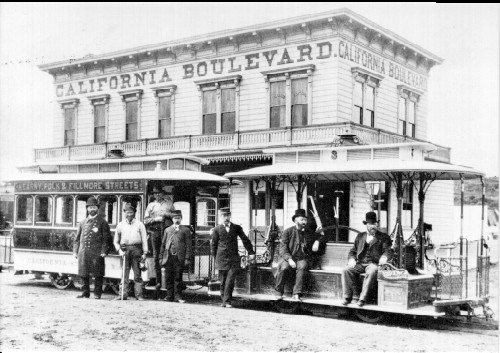
Transit fun fact: Fillmore Street developed as a commercial zone because of the 1906 quake.

California car at Fillmore. Building housed saloon and billiard parlor.
(Photo Credit)

Here’s another cool factoid from the amazing (out-of-print) book on the history of the San Francisco Municipal Railway.

We know Upper Fillmore Street today as a bustling commercial district with high-end shops and restaurants married closely with its residential community. This is a direct result of the great 1906 earthquake.

After the quake, the Fillmore Street cable car line was the first line restored to service. The downtown shopping district was still buried in rubble, helping Fillmore Street become the temporary retail and civic epicenter of the City.

This page on the history of Japantown describes how “old mansions served as department stores, and churches and synagogues doubled as courthouses.” The Muni book didn’t go into as much detail, but the Japantown page also described the transition of Upper Fillmore Street to evolve into what we now refer to as Japantown.

I think it’s easy to forget how strongly transit can shape our City.

Posted in econ, transit | Tagged , , , , , , , , , , , , , , , , , , , , , , , , | Leave a comment

UCSF makes its own power. Why?

UCSF power plant (fake)

This past weekend I took a guy home early in the morning at the end of his night shift at the University of California, San Francisco‘s power plant. At first I thought he meant he works to maintain the big power generators that serve as backup for the hospital and research facilities in case of a power outage.

No, it actually turns out that UCSF generates their OWN POWER 24/7 with a small scale natural gas power plant. They find it much cheaper to operate their own power plant than to purchase power from the grid.

UCSF is not alone. A quick Google search reveals Princeton and the University of Texas at Austin both operate power and heat generation plants.

Why do they do this? Why don’t they just use grid power and avoid the hassle? Is it really cheaper to operate their own plants?

Here are a few thoughts why universities operate their own plants:

  • Although the cost savings of generating their own electricity may not alone justify operating their own plant, they all seem to use the dirty exhaust as a heat generating source. The plant generates electricity and provides central heating for the campus. Now their natural gas (or coal) can be used for double duty.
  • Maybe the cost of transport (borne by PG&E) increases the cost of electricity enough that generating it locally for a large customer makes more sense? My guess it probably not.
  • Perhaps PG&E’s physical monopoly status allows them to charge high prices compared to the actual costs of generation. While consumers don’t notice because they use such a small amount of power, maybe large customers become aware of the artificially high costs since they have an option to generate their own power and can directly compare real costs of power generation.
  • Thoughts?
Posted in econ | Tagged , , , , , , , , , , , , , , , , , , , , , , | Leave a comment

Driving cab on Christmas day

old school cab in the snow

After a disappointing shift on Monday (Christmas Eve Eve?) from midnight ’till 11, I figured Christmas Day from midnight ’till 11 would be even worse.

It turns out the Christmas Eve revelers were out in full swing. Summary after the break.

Continue reading

Posted in taxi, work | Tagged , , , , , , , , , , , , , , | Leave a comment

Reason #4395 to love Starbucks: They’re open on Christmas day.

starbucks plus santa equals love

Starbucks haters, feast on this: Starbucks slaves its poor employees on the day we celebrate our good Lord’s birth. How can they be such careless, soulless, evil human beings as to force poor hourly employees to brew coffee instead of spending precious time with their families?

No other coffee or donut shop in the City was open early on Christmas day except for Starbucks. Further evidence, you haters say, that Starbucks’ corporate evil drives it to do things a locally owned shop wouldn’t even dream of! Right?

WRONG! I believe Starbucks is actually helping its employees by being open on Christmas.

I was getting drowsy on my graveyard shift and stopped by the Starbucks on 18th at Castro. I asked the cashier if he had drawn the short straw to get such a lousy shift. He laughed and said, “Oh no, I WANTED to work today! I didn’t have anything else going on — everyone’s out of town — I might as well make some money.”

There was most definitely demand for coffee on Christmas day. The line snaked out the door at times, just as it does any other early weekday. Face it, haters, some people want (need?) to drink coffee or eat expensive pastries on Christmas day. And, some people want to make money working at Starbucks on Christmas day. That’s right, they WANT to work there.

Some might say: shouldn’t Starbucks offer a paid vacation day on Christmas for its employees? Wouldn’t that be a nicer gift than ‘allowing’ them to work on the 25th?

My answer: if mandated by government, or demanded by the market for jobs of similar type, of course they will offer vacation time as a function of hours worked. But, forcing all employees to take Christmas as a paid holiday is silly. Some people don’t want to do so. Perhaps an atheist would rather take a vacation day when his friends visit next month. It makes more sense to offer no mandated paid holidays. Instead, issue the equivalent number of days for use anytime.

Thanks, Starbucks, for moving us forward, even just a little bit.

UPDATE: Today in Santana Row, a planned outdoor mall, restaurant and residential development in San Jose, the only open restaurant in the main square was Starbucks. About a hundred people lined the square and sat at (closed) competitor restaurants’ outdoor seating areas drinking and eating Starbucks products. Go Starbucks!

When I asked the servers in Santana Row, they also said they volunteered to work today. They get double pay.
Posted in econ | Tagged , , , , , , , , , , , , | 1 Comment

Crazy Idea: What if City cabs had variable pricing?

Taxi top light with 3 colored lights - red, yellow, green

What if each City cab were to have a bright green light which, when lit, indicates fares are half of the normal price? During off-peak times I can cruise for nearly as long as an hour without a fare. When it’s dead at 4 in the morning I’ll often drive by people stuck waiting for the MUNI. God knows when a bus will finally show, but the regular cost of a cab is still too much for them. What about half-price? Would that be enough to convert some people to take a cab?

Conversely, what if each cab were to have a bright red light which, when lit, indicates fares are double price? (Or, perhaps 150% of the regular fare.) At peak times it can be nearly impossible for people to hail a cab. Doubling the price would significantly cut down on demand for cabs. At this price some people would consider other options including, but not limited to, splitting cabs with strangers to save money.

Would this result in higher incomes for cab drivers during both peak and non-peak shifts? Or, would it just ‘even out’? Would this result in higher economic utility (usefulness) for customers? People may grumble at the double or 150% fare, but those that ‘really’ need a cab would be much more able to find one during peak times. And with half-price fares in the wee hours of the morning, MUNI exiles would have a safe and quick way home.

Right now we have neither variable pricing nor variable supply of taxicabs. Drivers get screwed at off-peak times, while customers get screwed during peak-times. Of course, variable pricing for taxicabs is just a thought experiment — I think it would prove too difficult to implement. But, it’s an interesting alternative to the more realistic option of variable supply, known as ‘peak medallions‘, which I strongly support.

Posted in econ, taxi | Tagged , , , , , , , , , , , , , , | 2 Comments

What’s with all those dashboard warning lights in taxicabs?

warning light

Some drivers try to hide dashboard console warning lights with Post-It Notes. Sometimes, I’ll fold a receipt and stick it between the dashboard plastic cover and the dashboard bevel. Most drivers don’t give a crap and let their amber lights shine with pride.

Why do cabs always have warning lights? Should you be worried? Short answer: don’t worry about it.

Almost every cab I’ve driven has at least one warning light. The most common culprit: the alternator warning light. The alternator converts electricity from the mechanical motion of the engine to charge the car’s battery, which powers everything from the CD player to power steering and even the automatic transmission.

In most cabs, the alternator warning light triggers because the alternator is working super-duty to power all the extra electronic accessories in a taxi: the (sometimes functioning) security camera and hard-drive based recording equipment, a high power radio receiver and transmitter, the taximeter with battery backup (so it won’t lose the fare amount if you need to shut off the engine for a bit), the taxi top light, and additional computer or GPS equipment. That’s a lot of juice. The warning light trips because the alternator can’t keep the proper amount of voltage — at least not the expected voltage if it weren’t powering all this extra stuff.

The second most common culprit: low windshield fluid.

Nothing to worry about.

Posted in taxi | Tagged , , , , , , , , , , , , , | 2 Comments

Is Fair Trade coffee really ‘fair’?

Fair Trade Certified Logo with a superimposed question mark in red

Is Fair Trade coffee really ‘fair’? The short answer: no.

EconTalk’s Russ Roberts chats with Duke Econ Prof Michael Munger about the concept of Fair Trade Coffee. It’s a very difficult challenge to ensure that a consumer price increase correlates with a laborer salary increase. But, even assuming that this difficult challenge is overcome, here is the resounding problem with the Fair Trade concept:

  • What is the purpose of increasing the pay of unskilled labor in developing countries? By artificially increasing pay for a job that requires no learned skills, this discourages learning skills that would result in higher paying jobs in a freer market (without these artificial pay increases). Put more simply: what is the motivation to learn how to use a computer when working on the farm pays just as much? Allowing unskilled labor to remain a poorly paying occupation encourages a country’s economy to develop more highly skilled opportunities.

If I were religious, I would subscribe to the religion of free trade. Amen, Russ.

Link (Direct Link to MP3)

Posted in econ, marketing | Tagged , , , , , , , , , , , , , , , , , , , | 6 Comments