Driving highlights

I only worked 2 days this week as I had an interview during my regular Tuesday shift.

  • The City was busy, especially Monday morning. The 2008 RSA Security conference started Monday at Moscone Center. I was surprised to hear a piece about it on NPR that morning. The City is building anticipation for the Olympic Torch procession Wednesday. San Francisco is the only North American stop for the torch. Finally, the San Francisco Giants held their home opener Monday afternoon, bringing a lot of fans from the region and beyond into the City.
  • I answered a radio call Monday midday on Russian Hill. I picked up a dad and his young son. They were headed toward the Ferry building for lunch with family friends before heading to the game.

    Stereotyping, the Blackberry wielding dad was the sort of guy I would pick up at 4 or 5 am to take to work in the Financial District — constantly busy and heavily invested in work. I was happy to see he took the day off to spend it with his son. Also happy was his son.

    Some customers inspire me to drive quickly. If a passenger is clearly in a hurry, or if I don’t get a good vibe, I’ll attempt to reach our destination as quickly as possible. Some customers inspire me to drive safely. All young passengers and most elderly passengers inspire me to take extra care, above and beyond that which I would exhibit were I the only passenger in the car.

    It was with that spirit that I drove leisurely down Jones to make a left on California toward the Ferry Building. I could have gone faster snaking around to the Broadway Tunnel, or maybe even winding up over Telegraph Hill, but this was the simplest route.

    With each and every passenger, even those for whom I drive with an extra degree of safety, I always have a general feeling that we need to reach our destination in a reasonably quick period of time.

    Thanks to our young passenger, this was the first time when I felt external pressure to NOT reach our destination quickly. This was the first time I came to believe that perhaps humans aren’t inherently tuned to a sense of external time and that, perhaps, this is learned behavior in present day society. Unfortunately, this learned external pressure of time weighs down on each of my fares as I seek to maximize my earnings and they to maximize their day.

    This young man was all eyes on the world around us, the world of his father, and the upcoming baseball game. He was already maximizing his day.

    To his father, “Will we ‘talk baseball’ soon?”
    To his son, “Sure, we can talk baseball whenever you like.”
    “Will there be donuts at the baseball game?”
    “Maybe not donuts, but I bet they’ll have cotton candy.”
    “Will Aunt and Uncle So-and-So join us at the Ferry Building?”
    “You bet! That’s why we’re going.”

    At the intersection of Jones and California I felt for one moment the pure and intense positive energy he exuded. The only Radiohead song I like played softly on the aging Chrysler minivan speakers. We waited silently at an extended red traffic signal as the California line cable car preempted our cycle. Tourists looked through digital camera viewfinders toward the expansive view and historic landscape. Dozens of cars whipped perpendicularly by four times faster than the cable car. Old chinese ladies and young white yuppies walked up and down California. A San Francisco Fire Department ambulance wailed by and drowned out the music, again preempting our green light cycle and extending this moment of bliss a minute longer.

    Thanks, father and son.

  • I witnessed a police chase early Sunday morning.

    I was heading south on Mission just after 23rd Street. Having no passenger, I hugged the right hand of two lanes tightly, choosing curb proximity over speed in the customary fare-hunting position.

    This habitual curb hunting proved a safe bet as in my rearview mirror a 1990’s era Ford Explorer sport utility vehicle with illegal front tinting and a noticeably lowered suspension quickly approached. While my emotional speedometer would estimate he was going 80 mph, my rational speedometer suggests he was closer to 60 mph, still an extremely dangerous speed to run red lights along Mission which has heavy pedestrian and vehicular cross traffic frequently granted right-of-way across the four lane boulevard.

    The driver of the Ford Explorer was barely able to maintain vehicular stability as he turned left on 24th Street from Mission. Following two blocks behind were two black and white Ford Crown Victorias, both fitted with flashing light emitting diodes and wailing sirens. The operators of these Fords were official agents of the State, encouraged and authorized to apprehend persons driving at dangerous speeds by pursuing at dangerous speeds.

    They followed left on 24th Street, as did I. Two more Ford Crown Victorias soon passed me, coming north along mission and turning so quickly on 24th Street that I barely had time to get out of the way.

    I thought to myself, should not the Ford Motor Company feel a tinge of pride that its vehicles were the sole stars of this dangerous soap opera? I also thought, should not the State pursue safer methods of non-safe driver apprehension that do not involve State agents mirroring this same unsafe driving behavior?

    I also thought, what’s the chance that the Chronicle will report this? (They didn’t.) I think now, perhaps they just don’t report things that happen on Sundays? Or, maybe, they just don’t report things that involve the jeopardization of safety for the City’s lower income residents?

Posted in happiness, taxi, work | Tagged , , , , , , , , , , , , , , , , , , , , , , , , , , | Leave a comment

Making a complex customized Django form template? Remember to include form.non_field_errors!

This drove me crazy for about 30 minutes.

If you’re making a heavily customized form template with Django, the newforms documentation suggests this format:

But, if you do any sort of non-field specific (form-level) validation, those validation messages won’t be returned to the user. So, instead of seeing a message like, “Both password fields must match,” the form just reloads without a explanation, confusing our poor end-users (and me for about 30 minutes)!

A quick #django IRC session later and I had the answer: form.non_field_errors

This did the trick for me:

I’m no professional developer, but a lack of Google search results for this matter inspired me to make a quick post and tag it well so future Django form template customizers don’t pull their hair out.

(Sorry to post the code as images, but [hosted] WordPress doesn’t escape HTML enclosed in code blocks! Ridiculous.)

Posted in internets, tech | Tagged , , , , , , , , , , , , , , , , , , , , , , , , , , , , , , , | 13 Comments

Driving highlights

It was a tough weekend.

  • It was slow Monday and Tuesday in the City.

    I am learning, albeit slowly, to let go of the natural feelings of elated success or critical failure that come from a high or low earning day. This is important.

    While there are many factors over which I have control — the areas of town where I roll around seeking street fares or radio fares, the speed with which I drive, the choice of van or car, whether or not to sit in hotel or airport taxi queues — the most important factor that determines my earnings is outside of my control: demand for taxicabs during a given shift.

    I think it is a natural human thought process shortcut to overly attribute successes or failures of a given activity to yourself.

  • On a rather quiet Tuesday morning I ambled around in the Marina around 9:30 after the morning rush was over. I answered a radio call in the deep Marina near Broderick and Chestnut.

    I searched out the address and was surprised and happy to realize it was the same elderly lady I had picked up a few weeks ago. She regularly heads out to the UC hospital on the other side of town for continuing physical therapy related to a leg injury.

    Her injury makes it difficult for her to descend the many stairs in front of her apartment. I accompany her down the stairs with patience while we start to converse. She is blessed with an endlessly spunky wit.

    Occasionally people make requests to stop and pick something up. Sometimes it’s a quick trip to the ATM, absolutely necessary and in my own interest, of course. Sometimes it’s a quick stop to get something and return back to where we started, that’s good too as it’s a quick double fare.

    But, sometimes it’s a frustrating waste of my time. I earn less while sitting in place than in motion, even as the meter ticks up for idle time. I accept quick shopping requests (“I just want to grab a water, newspaper, cigarettes, etc.”) with apprehension, sometimes denying them depending on a variety of variables (remaining distance to end destination, total fare, politeness of request, their understanding of my time and perceived willingness to tip appropriately, current City demand for taxis).

    So, when this nice lady asked to stop to get a cup of coffee I was torn. I couldn’t say no, she was too nice. And, the City wasn’t busy at all. And, she was actually a lot of fun to hang out with. And, there was a surreal sense of humor in the whole situation. And, she has a really hard time walking right now so the least I can do is help her get a cup of coffee.

    She takes a few minutes to get down the stairs and climb in the cab. We head around the corner to the ‘coffee shop’ which turns out to be a liquor store which also serves coffee and donuts in the morning. Wow, not what I expected, especially considering San Francisco is the coffee shop capital of the world.

    She tells me, “Just ask for Margaret’s coffee and they’ll know how to make it.”

    I head in and ask Robert behind the counter, “Can you help me get Margaret’s special coffee?” For the record, Margaret’s special coffee is 1/3 half and half and 2/3 coffee. I also get her a chocolate donut per request. I am smiling throughout this experience, finding humor in every element from her innocent, yet absolutely clear breakfast demands to Robert’s deep rooted understanding of Margaret’s more than 20-year history of coffee needs.

    Freshly caffeinated, Margaret directs me on our previously worn path toward the UC hospital via the Presidio. As before, it was pleasant and relaxing. I quizzed her throughout the trip about her past — where she was born, what brought her to the City and the evolution of her life in the City.

    She didn’t have any paratransit scrips left, so she wasn’t able to tip as much as she would have liked paying in cash. The difficulty with which she parted with an extra dollar after paying the fare was tip enough.

    Thanks, lady. Hope to see you again.

  • The Muni Metro broke down around 10 am Tuesday morning. It didn’t last very long, but it was long enough to instantly increase demand for taxicabs.

    At moments like these I (and stranded City residents) realize the amazing service provided by a properly functioning City taxi fleet: it is a last resort safety net, always around 24 hours a day, 365 days a year, providing emergency transportation solutions. Wow.

    Somewhat related, I took a break and went in for coffee and a bagel at It’s a Grind, one of my favorite neighborhood coffee chains. I chatted a bit with one of the employees and they complained a bit about the morning rush.

    Complaints? About the morning rush? Wow, what an opposite (literally opposite) view on the morning rush compared to mine. As I am paid directly on performance, a fare, which could otherwise be called ‘work’, is a desirable item. A fare may be ‘work’, but I view it as money in my pocket. Contrast that to an hourly worker at the coffee shop who gets paid regardless of how many customers come in the door. Each additional customer is more work, no additional pay.

    In the world of hourly compensation additional customers are a pain. Weird.

Posted in taxi, work | Tagged , , , , , , , , , , , , , , , , , , , , , , , , , , , , , | 1 Comment

News flash: Livable cities are sustainable cities.

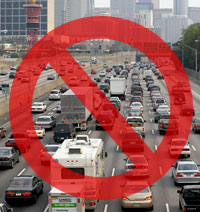
No congestion!

NPR’s Morning Edition recently featured an excellent two part series on the aggregate effects of our living decisions on the environment.

The stories hit hard from the angle that suburbia increases per capita carbon footprint while denser, urban living offers significantly lower per capita carbon footprint. Yes!

Here’s the underlying important point: living in denser areas can INCREASE quality of life while DECREASING our impact on the environment. Wow, a win, win?

So, what’s the problem? It takes a coordinated partnership between centralized government and private developers to create these desirable dense urban areas. It doesn’t happen by itself. As seen in Atlanta’s sprawl, if left to private developers with minimal government intrusion, suburbia will continue expanding.

Here’s a dose of crazy: what if suburban housing prices didn’t properly take these cost of living issues into account? (That is, what if the value of suburban real estate didn’t take into account the cost of living decrease caused by significant commute time and energy costs?) What if, in addition to our current short-term housing pricing adjustment, suburban real estate will have a long-term trend downward (or, at least, not upward) relative to urban real estate? This downward pressure will only increase as energy prices continue to rise.

Links

BONUS: Related, check out this NYTimes story about New York’s continuing love affair with cars despite increasing energy costs and an impending congestion fee near city center.

Posted in happiness, politics, transit | Tagged , , , , , , , , , , , , , , , , , , , , , , , , , , , , , | 1 Comment

Driving highlights

i love san francisco tourists

  • (Last week) I picked up an attractive young lady from a hospital out in the Richmond and took her back toward work downtown. She was (and my best guess says she still is) British and we chatted about about how she came to live in the US. All of a sudden, she clammed up. I think she thought I was hitting on her.

    Was I hitting on her? I wasn’t trying to. I was, however, trying to make conversation.

    Does that mean I’m hitting on elderly ladies when I make conversation with them? What’s the difference?

    If I try to make conversation with an elderly lady she’ll consider that just “being friendly”, whereas making conversation with an attractive female near my age necessarily indicates a desire for fornication?

    Women are frustrating.

    Let’s take this one more step. When I go to gay bars I’m often hit on by guys. Some, perhaps not all, desire fornication. Does that mean I should clam up and refuse a conversation with these men? On the contrary, I enjoy talking to nice people, regardless of their desire to have sex with me.

    Perhaps I’m reading too much into this, but this behavior has been repeated enough times in San Francisco that I begin to notice a pattern.

  • No updates on the bag. I think it’s a goner.
  • On a closely related topic, as my street map and taxi cross-street index are now in the trusty hands of a lady (man?) of the night, I am rolling around the streets of San Francisco with no map, no guide.

    I feel like a ‘man’. Gosh, I’m on top of this. Map? I don’t need a map. Maps are for losers.

    My bubble was quickly burst this morning when a nice lady asked me to head toward Duncan and I made a turn in the opposite direction. Oops.

  • I love tourists. I can’t say this enough. I LOVE tourists.

    The City is vibrant again with the flush wallets of spring breakers, gap year partiers, and foreigners cashing in on a weak dollar.

  • (Today) I picked up a few nice young ladies heading toward Pier 39 from their ritzy boutique hotel downtown. They had partied the night away. Actually, they had partied both nights and days they had been in the City, leaving them with a great many drunk tales but no photographic proof that they had seen the traditional tourist icons of the City.

    San Francisco cabbie to the rescue! As Lombard Street was just a few blocks out of the way toward Pier 39 I offered to take a quick detour down the famous curvy street. We stopped to take some picturesque photos at the top of Hyde and Lombard which offers great views of Coit Tower, Alcatraz and the Bay Bridge. I then snaked down Lombard with cameras clacking in tow.

    This is a great way to turn an $8 fare into a $15 fare (including tips). It would have been $6 or $7 with $1 or $2 tip if I had gone direct. With our detours it was $10 and they gave me a $5 tip. Judging by their reactions they got way more than $7 of incremental value. Win, win.

    PS. I learned this trick at the great, great Bill Hancock school of Taxi. Looking past his antiquated website with embedded midi, this course was a pleasure and highly valuable at only $150. Take it if you’ve ever thought of being a cab driver.

  • I witnessed a miracle this afternoon.

    I picked up two very nice older ladies — one from Chicago and the other, well she was from Chicago too, but it sounds more exciting to note she was originally born in Argentina and retained the appropriate accent. Alone, they weren’t the miracle, but they were very nice and made quite pleasant conversation. No, they deserve more credit. I guess you could say it was they who caused the miracle.

    They were heading out to the Legion of Honor, way out in the Outer Richmond. You see, when a cab driver gets a fare way out to the Richmond or the Sunset, he or she is happy enough to get a return fare, even if it’s not going all the way downtown, as long as it’s something. Any fare is a bronze, a fare going back downtown is a silver, and the gold medal is always an airport.

    Well, my fair readers, upon arrival to the Legion of Honor I was most surprised to come across not only a bronze, not a silver, not even a gold, but a silver PLUS gold medal fare. Shall we call that a platinum? A nice young English couple needed to head back downtown to grab luggage from their hotel and then promptly head to SFO. Would I be so kind as to take them, they inquired?

    No problem, I said. Bingo! $60 fare. Add that to the $20 that the old ladies gave me, and this really made my day. A Festivus miracle!

    I love tourists.

Posted in taxi, work | Tagged , , , , , , , , , , , , , , , , , , , , , , , , , , | Leave a comment

Website highlights financial stress of driving a taxi in the City

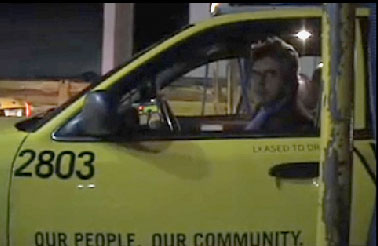
San Francisco Yellow Cab 2803

I point your temporary attention to a Flash website produced by UC Berkeley j-school grad students Eric Zassenhaus and Amy Jeffries.

The video clips thumbnailed along the bottom are accurate and colorful paintings of a typical taxi shift. Well worth a view.

But wait, there’s more. The site also features insightful interviews with Heidi Machen, the SF Taxi Commission Executive Director; Jim Gillespie, Yellow Cab President; and Thomas George-Williams, United Taxicab Workers member.

Since I drive a cab in the City and can’t shut up about local politics, I have some pointed reactions:

I don’t know who Heidi Machen is or how she got to be Executive Director of the SF Taxi Commission, but she doesn’t seem to have an accurate grasp of the industry over which she regulates. This is a bit scary.

When asked about the recent gate-fee increase, Ms. Machen responds with a bubbly response. “In many ways it’s very positive,” she starts, repeating again for emphasis, “in many ways it’s very positive, because, if indeed the taxi companies needed money to purchase the alternative fuel and hybrid vehicles San Francisco is looking at a clean taxi fleet in 3-4 years. Wow! That’s phenomenal!”

“If indeed?” If indeed? Ms. Machen, your job, for which you are paid a bulbous salary of some sort, is to be Executive Director of the Taxi Commission. There should be no “if” in your response. You should know whether or not taxi companies need money to purchase alternative fuel and hybrid vehicles BEFORE implementing fee increases.

Continuing, “On the other hand you look at the controller’s report and the controller said this would have an immediate detrimental effect on taxi drivers’ incomes. So, that can be a negative, obviously, because taxi drivers, a lot of them, may be hanging on marginally. On the other hand, maybe it encourages taxi drivers to become more efficient. Some would fear it would make taxi drivers more reckless.” Ponderously she summarizes, “I think there are some positives and some possible negatives that we’re looking at.”

My fear is she doesn’t seem to “get it.” A key sticking point: taxi companies need CPI gate increases but drivers also need correlated revenue increases. The discussion of green cabs is a sideshow distracting from this core issue.

On the other hand, Mr. Gillespie in his role as General Manager of Yellow Cab understands the situation perfectly. Unfortunately, his role is not an advocate for drivers but instead for revenue maximization for Yellow Cab. (This is not a judgment of his motivation, just a recognition thereof.) But, at least he “gets it.”

Thomas George-Williams, an active member of the local United Taxi Worker union “gets it” too. But, as most drivers are not members of the Union, its influence, regardless of Mr. George-Williams “getting it,” is unfortunately questionable.

Link

Posted in econ, politics, taxi, transit | Tagged , , , , , , , , , , , , , , , , , , , , , , , , , , , , , , , , , , | 2 Comments

Dear Transgender Prostitute: Why did you have to take my bag?

Dear Transgender Prostitute

I picked you up, you looked legit. Alright, it was a little late, 2 am, and it was in the Tenderloin. Larkin and O’Farrell doesn’t produce the best of customers even during the day. But, I’ve encountered people a lot weirder than you so I figured it was worth a shot. And, most of your transgender prostitute brethren are neither thieves nor scoundrels and treat me politely with usually gracious tips. I should have realized you were fishy when you changed destinations twice.

Listen, I understand that we all have to pay the bills and all, but why did you have to take my bag? It’s not that I lost valuables, it’s just that I have to now replace all this crap.

Next time, maybe you can ask me something innocent like, “Gosh, what do taxi drivers keep in their bags?” Undoubtedly, you solved this bland riddle to your disappointment shortly after I dropped you off at 11th and Howard. I’ll fill in our online readers who aren’t as unabashedly curious as you:

  • A Thomas guide map ($30 new, well worn and torn — worth $5 if anything)
  • A few AAA maps of the surrounding regions ($10)
  • A taxi guide book giving street intersections ($7)
  • A tire pressure gauge ($3)
  • A cassette audio input adapter ($4)
  • The bag ($10 at Target)
  • A library book (I’m curious what SFPL will charge)

Fantastic, now I get to waste a whole afternoon replacing this junk. And for what? Maybe you’ll make $10 off of everything, not including the $6 fare you paid me. Four bucks?

What did you think was in there? Do you think cab drivers stuff wads of cash in their bags? Do you think I’m rolling around the Tenderloin with a MacBook Air in my bag? Wrong!

Thanks a lot, man. (lady?)

Posted in happiness, taxi, work | Tagged , , , , , , , , , , , , , , , , , , , , , , , , , | 4 Comments

Something Muni does well: Trolleybusses

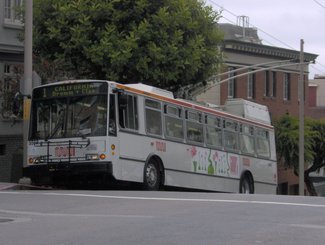
1 California trolley bus

I am so fond of ragging on San Francisco’s poorly managed Municipal Railway that I often overlook Muni’s remarkable, world-class achievements. (Yes, they really do have some remarkable, world-class achievements.) This post is a first attempt at fixing my glaring oversight.

Muni’s extensive trolleybus system is a modern treasure. Muni claims to hold the largest trolley-bus fleet in the US and Canada. Trolleybusses are efficient, consume little fuel, recharge via regenerative braking, require little maintenance, are quiet, and produce zero localized pollution.

  • Electric motors are more efficient than diesel motors, especially climbing steep grades.
  • Trolleybusses offer ZERO local emissions. Diesel fuel engines on the other hand, the most common local locomotive for municipal transit busses nationwide, produce a fine particulate matter byproduct that may be a health risk.
  • Trolleybusses are not tied to any particular energy generation source. The local transit agency can purchase power from private generators, government-owned generators, create their own local power plant, use solely green power, etc.

Keep up the good work, Muni. Maybe the 38-Geary, the highest ridership bus line east of the Mississippi, can convert to a trolleybus when it hatches from its BRT cocoon.

Links

Posted in transit | Tagged , , , , , , , , , , , , , , , , , , , , , , , , , | Leave a comment

“Energy independence” is silly. We must use less energy regardless of its source.

Jerry Taylor, Cato Institute

My unwavering allegiance to the American Public Media radio program Marketplace was made ever tighter by a clear and compelling opinion piece by Jerry Taylor of the Cato Institute.

The piece is written so concisely I can do no better than to quote Mr. Taylor’s introduction:

President Bush and many others are fond of saying that oil prices are high because we import too much oil. In reality, they’ve got it exactly backwards. We import energy for a reason: it’s cheaper than producing it here at home. A governmental war on energy imports will, by definition, raise energy prices.

Bingo.

Our search for the holy grail of ‘energy independence’ has distracted us from the real issue at hand: we have built our country, our cities, our communities around a transportation infrastructure that relies almost solely on fossil fuels. When the cost of these fuels increase faster than expected, the repercussions are multiplied: not only does it cost more for you to drive to a market to purchase goods, the goods cost more to produce and deliver since they rely on that same transportation infrastructure.

Oops!

Our national focus should be on changing the policies that have led us to rely so heavily on fossil fuels instead of debating from which source we should purchase these fossil fuels.

Links

Posted in econ, media, politics | Tagged , , , , , , , , , , , , , , , , , , , | 6 Comments

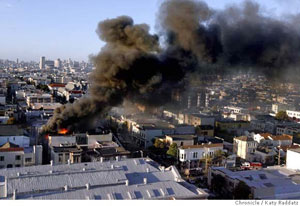
Fire destroys low-income resident’s apartment. Archaic rent control forces her to leave City.

mission district fire

The Chronicle has a touching and well-written article about the aftermath of the Mission District fire that completely destroyed a 30-unit apartment building Monday evening.

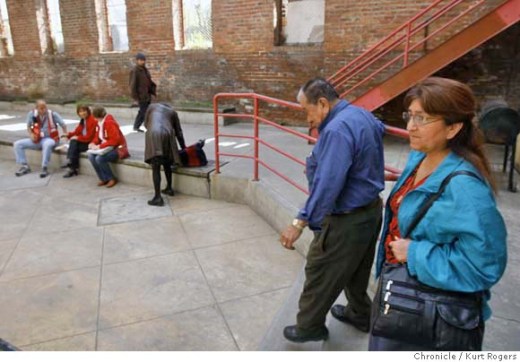
Central to the article is the story of Griselda Paleo. Ms. Paleo is 59 and lived alone in a studio apartment in the building. Her apartment was tied to an 18-year old rent controlled price of $698. Her income is $850 from a federal disability program. How can Ms. Paleo relocate in the City? Short answer: she can’t.

Studios in the City start at $1,000 per month, it’s hard to find a decent quality one at $1,200. Even sharing an apartment will likely use her entire income stream.

Since rent control regulations tie the stabilized apartment price to that particular apartment, if that apartment is destroyed, transferred to a live-in owner, etc, the tenant loses that price control. That is what happened with Ms. Paleo.

Ms. Paleo’s case shows that tying price controls to a particular property is a critical failure of rent control policies as implemented in San Francisco and some other big cities, notably New York City.

Rent control is a form of welfare paid to tenants regardless of income and paid solely by rental property owners. Welfare for low-income residents to live in our City is good. But, offering housing welfare to all residents regardless of income, supported only by property owners is silly.

Instead, the City should offer a rent SUBSIDY program, financed by all City residents that stabilizes rental unit prices for low-income tenants. Among other benefits, this would not tie a tenant to a particular property as in Ms. Paleo’s case.

A rent subsidy program in place of rent control offers a number of benefits:

  • Ms. Paleo would be free to move to any apartment in the City, whether displaced by natural disaster as in this case, or by her own choosing if she wants to move to a new neighborhood.
  • Tenants who do not need assistance will not be eligible. Ms. Paleo obviously needs rental assistance, but an investment banker with an income of >$100K should not be eligible for rent assistance. With the current system there is no way to differentiate the investment banker from Ms. Paleo. This is silly.
  • The cost of the program would be borne by all City residents, not just rental property owners. This is important. Since rent control is a significant tax on property owners that choose to rent their property, this significantly limits the number of properties put on the rental market. By removing the rent control tax and instead spreading the cost of rent subsidies to the entire population, we allow the rental property market to operate much more smoothly.

Our Supervisors and Mayor wouldn’t touch the idea of changing the rent control structure with a ten foot pole.

City leaders, your inaction has forced Ms. Paleo to leave our City.

Links

PS. Rent control is better than nothing. It’s a good start, but it’s just not the most effective solution we can come up with.

Hugo Gonzalez and Griselda Pal
Hugo Gonzalez and Griselda Paleo walk through the patio at a Red Cross shelter set up at the recreation center on Harrison Street. Chronicle photo by Kurt Rogers.

Posted in econ, happiness, politics | Tagged , , , , , , , , , , , , , , , , , , , , , , , , , , | Leave a comment