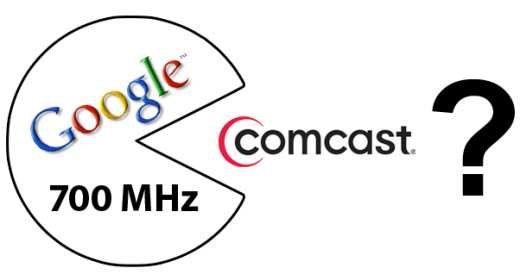
In 2006 the United States’ Federal Communications Commission decided to axe analog television. Analog TV, the kind of TV you received before you had cable and tweaked with rabbit-ear antennas, will go dark in 2009. Broadcasters have been transitioning to digital television, commonly known as HDTV, which requires a smaller part of the electromagnetic spectrum. (Physics primer: TV signals are just a form of electromagnetic radiation within a specified range of frequencies allocated by the FCC. High frequency electromagnetic radiation is visible as light. Read more than you could ever want to know on Wikipedia.)
Since digital TV uses less space on the EM spectrum, we can now use this extra space for something else. The FCC is holding an auction for some of this newly freed spectrum, specifically some parts of the UHF 700 MHz range. Google, among over 200 other companies, will be bidding in January for rights to these chunks (in addition to chunks available only regionally).
Most blogs and news outlets discuss Google’s imminent domination of wireless carriers. Dreams run wild of Google coming to save us from the oligopoly of oppressive mobile telephone operators. Or, some think Google might step in and be an angelic ISP, providing free or nearly free wireless access.
The sad truth is the bandwidth being auctioned is relatively limited. It’s probably not enough to operate a full fledged mobile company. It might be suitable for a wireless ISP, but perhaps at a prohibitively high cost due to the physics of the 700 MHz spectrum.
Instead, this spectrum might be most suitable for what it was used for before: television. The 700 MHz spectrum could be used as a backdoor to disrupting Comcast’s and satellite providers’ dominance of delivering video content.
Why is this spectrum not as suitable for wireless internet or mobile? Am I on acid? Would Google want to compete in the video delivery arena?
Let’s break this down.
Continue reading →







 kfarr
kfarr 