Driving Bay to Breakers

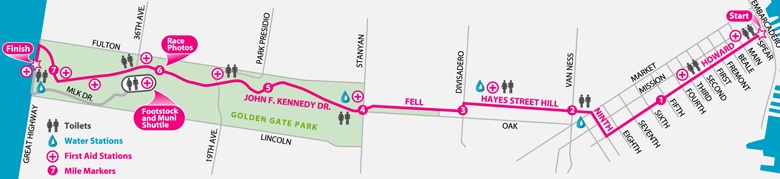
This weekend the City hosted its annual Bay to Breakers run. Bay to Breakers (B2B) is a 7 mile run through the heart of San Francisco. B2B starts from the east (bay) side of the City at the Embarcadero and runs directly west toward the ocean (breakers) side of the City.

B2B cuts through many varied City neighborhoods, starting with SOMA, briefly touching the edge of the Tenderloin on the way through Hayes Valley, Western Addition, straddling the panhandle around NOPA/Upper Haight and concluding through Golden Gate Park which separates the westernmost Richmond and Sunset districts.

Here’s a map:
B2B is more than a run. It attracts a large party crowd drawn primarily from the City’s ample yuppie supply. Party goers slowly trail the legit runners dressed in costumes and fueled solely by alcohol despite the race’s early start time.

Last year I ran the race (unofficially) to see what all the hoopla was about. It was a blast. I woke up late but caught the race halfway through the City around Hayes Valley. I continued to run westward past and through the crowds of partiers. I was amazed at two things: a) the size of the crowd, and b) the important streets which the City closed completely during this event. Returning this year as a cab driver on the race day, I was hit hard by the impact of point b.

Between 8 and 10am the north and south ends of the City were completely severed save for Park Presidio on the far west side of the City and (eventually) the Embarcadero on the far east side of the City. This caused a great deal of frustration for non-race goers attempting to go about their normal Sunday business.

  • Having worked a number of City event days in the past, I knew a van would be a big asset. I was lucky to get a van as I requested from the cashier.
  • Before the race began, therefore before street closures, my passengers were a mix of hung-over partiers returning to their places after spending a night with a ‘special friend’ and folks going to work annoyed at the lack of Muni service on some key lines. (A normal Sunday crowd.)

    Soon after 6am I started taking a number of people from their homes to other homes for ‘pre-partying’ and soon after I took many more groups to the start of the race course. Between 6 and 7am the City’s aggregate demand for cabs exceeded available supply. Demand did not return below supply at any point during my shift — an exceedingly rare event for a Sunday day shift.

  • After the race began, I was ‘stuck’ on the north side of the City. Given the extremely high demand for cabs, either side would be an okay side to be ‘stuck’ on. But, the north side of the City holds the majority of housing for the yuppie contingency, so this was a good place to be.
  • While stuck on the north side of the City, I picked up an older lady with very limited English from the St. Francis Hospital. She asked me to go south of Market a few blocks further south than would be possible given the race street closings.

    I did my best to clearly explain to her that this would simply not be possible. I even used a nice visual aid provided by the cab company — a map of the race route like above. This didn’t phase her. Oh well, I thought, as soon as we get closer she’ll get the picture.

    We crossed Market on 5th and approached Mission at which point the crowds and street closure at Howard was plainly visible, if for no other reason than the haze of red brake lights blocking our path.

    I stated the obvious, “This is as far as we can go. I’ll have to let you out here.”

    She was not happy. “I need to go to Folsom!” I first tried polite reasoning which soon escalated into more blunt statements. “Look, lady, it’s not going to happen. You have to get out here and walk the rest of the way.” (It was just 2 blocks south.) I figured her sole human form would have a significantly higher chance of crossing the path of running humans than a blue hulk of taxi metal crashing through police barriers.

    She protested for about a minute. I’ll let you know that a minute is a very long time in a City where there were hundreds of street hails calling out to me at this very second. (Like Superman’s super-ability to hear dames in distress, I could hear calls of ‘Taxi’ crying out in pain across the City.) She finally accepted her fate and I moved on.

  • I found my next street hail in less than 10 seconds. A nun urgently needed to get from 5th and Mission to 30th and Mission, far south of our present location, to be the church representative for some sort of concrete pouring on a construction project.

    Despite her niceness and her lifelong dedication to God, her reasoning skills were questionable which became more and more evident as we attempted to get around the race. “You want me to drive the entire length of the race course until we find an opening?” I said. I thought, this may not be a good idea.

    “I think the only opening right now is Park Presidio on the far, far west side of the City.” I thought, do you have an understanding of the cost of this circuitous cab ride? About 3 minutes into the ride she revealed she only had $10 to pay me. By this time we were at Van Ness.

    What was she thinking? In retrospect I don’t think she was thinking very clearly at all. I had to call this off. We stopped near the race path at Hayes. I suggested she attempt to walk across the race path and hail a cab or find a continuing Muni line at that point.

    She thanked me and paid me for the fare. I was on autopilot — the meter read a fare and I accepted payment for that fare. In retrospect I feel quite shameful that I took her money. Obviously, the best thing for her to do would have been to take BART. Why didn’t I think of that before? She seemed very clear in her intent to have me find a magical break in the race that was obviously not there.

    I should have been more forceful in my initial questioning of her questionable plan. I should not have accepted her payment. She should not have asked to go on a cab ride significantly above her ability to pay. We’ll do it better next time.

  • Continued on the next post…
Posted in taxi, work | Tagged , , , , , , , , , , , , , , , , , , , , , , , , , , , , , , | 2 Comments

Driving in the City is beautiful.

I eeked by on Sunday with my lowest Sunday earnings in a long, long time — only $87. This was offset by better than usual earnings Monday and Tuesday, both over $170 (over average).

  • I notice that fares run together in my memory more than before. I’m not sure of the cause. Do I pay less attention to customers? Am I becoming the cab driver that can chat up any customer without really listening to what they’re saying? (No, I don’t think so, but I still worry about it.)

    Maybe I start to see the same patterns of people over and over. What sets one business commuter apart from the other?

    Or, maybe I’m now waiting too long after my shifts to write these posts. (It’s probably that.)

  • Late mornings and early afternoons the Kaiser calls are off the hook — 2, 3 or 4 orders waiting for cabs, most of them armed with City paratransit scrips, ready to spend a nice clip going across town. I like Kaiser calls.

    The dispatchers call those orders as “Geary and Divis.” Or, when there are too many, they simply say “2 [3, 4] times for the Kaiser” or “Kaiser calling back.” Good times to be a cab driver in the City.

    I picked up a guy Monday from the Kaiser. He was older, extremely tall and moved slowly but precisely. When he walked it looked like a slow motion film. A 30 frames per second video played back at 20 fps.

    He was black but with rather light skin and noticeable freckles. But, his defining feature was his glasses. They were perfectly round, thick plastic frames. He wore classy khaki pants, a sports jersey and a dress shirt. He had great style.

    When he sat down in the cab he handed me a twenty. “That’s your tip.” Making the assumption that is best to be made in such situations, I assumed he meant, “That will cover the fare plus your tip.” People do that sometimes.

    He gave his destination neither as a request nor as a command. Just a statement of truth. A fact. Our destiny, as sure as the sun would set tonight and rise tomorrow. “We’re going to make a stop at the Cala [Grocery store at California and Hyde] and then back to my apartment at [address].”

    As I’ve said many times before, I don’t normally enjoy waiting. I have a well-founded propensity toward constant motion as I usually earn more while in motion than waiting, even if the meter ticks up for time at $0.45/minute. But, I didn’t argue. He seemed set in our path.

    We pull into the Cala and he gets out. I try to relax. I’m getting better at it, even in these situations where math constantly ticks through my head calculating how much money I’m losing while waiting for this guy to scan through the frozen food aisles.

    What I perceive to be minutes later (but is probably just a minute later) I turn around and look in the store. Maybe I’ll see him grabbing something from the impulse aisle so we can keep going. He’s still outside. Searching for a cart. He hasn’t even entered Cala. I try to relax again. Of course, the meter is still running.

    I listen to some NPR. I flip around from one NPR station to the other. Ralph Nader’s on KALW. Interesting enough.

    15 minutes later I blow my top. This is insane. The meter’s up to $15. I grab a cab receipt and write down my phone number, grab his medicine from the back seat and $5 change for his $20.

    I find him in the Cala in the frozen food section. But, I couldn’t maintain my anger at him. Restated, I couldn’t direct my anger toward him. It just wouldn’t go. I just wanted to laugh. Actually, I wanted to help him shop. Maybe things would go faster. And, he shared my taste in food. Frozen popcorn shrimp, nice! “There are things at this Cala I just can’t get anywhere else in the City.” Tell me about it.

    I said, “Look sir, you’re really nice and all but I really can’t wait this long. I need to find other fares. Here’s your change from the meter, your medicine, and a card with my number. Call me when you’re done and I’ll pick you up.”

    “Oh no, don’t give me any change, that’s your tip. I’ll pay you whatever’s on the meter. I’ll just be another few minutes.” Oh, really? Now the numbers tip in his favor. And, to his credit, his Cala cart was approaching capacity. “Okay, I can wait a few more minutes.”

    A few Nader tirades later and he finally emerges from Cala. “Thanks for waiting,” he said, “It’s hard to get cab drivers to wait for me to do my shopping. That’s the last thing on my list for the week. Now I can relax the rest of the week.”

    I took him a few more long blocks up to his Nob Hill apartment. He paid me another $30. “Woah, sir, you’ve paid me 50 bucks. This is a lot. Are you sure you’re okay with that? I have no problem giving you some change.”

    “No, no, take it, you were very helpful. I’ve done everything on my list.”

    I thanked him profusely and finally said what was on my mind, “You have some awesome glasses.”

  • I picked up an Indian guy and his girlfriend from the CalTrain station on Tuesday. I don’t think they take cabs often.

    He asked, “We are going downtown, are you going that way?”

    I wasn’t trying to be smart, but this just popped out of my mouth, “That’s not really how it works. I’m a cab driver, I’ll go wherever you tell me.” They told me to go downtown.

  • I scored an Oakland Airport fare off the street from 555 Market, the site of my former office job. Karma?
  • I dropped a guy and his elderly mom off at her retirement home from one of the hospitals. She was a bit out of it, so he was handling her paratransit scrips. He wasn’t sure where to sign and I pointed to the line and said, “Just fill in this field here. Did I just say field? I’m not even sure what the proper word is.” You see, I’ve been working a website quite a bit in my spare time.
  • I picked up a bouncer from a downtown club Tuesday morning. He had finished his graveyard shift and was heading home to his NoPa apartment. He talked about work. He worked a lot. 7 days a week. He made a lot of money. He spends it all.

    I felt like asking him, does that really make you happy? Do you like working 7 days a week? Why not just spend less and work 4 days a week? Or 3?

    I’m proud to share that I’m living below my means, (finally) paying off my credit card, and working only 3 days per week. I earn about $25k per year and live in one of the most expensive cities in North America. My secret? I don’t buy things. (Nor do I have kids.)

    I didn’t feel it appropriate to lecture him though. I think it’s a lesson people have to learn for themselves. Of course, I have no problem lecturing you on this blog.

  • I picked up a guy from a nice SOMA apartment building heading to SFO. We had a fun chat about politics, Obama and the state of the Union. As I dropped him at the terminal he said, “I’m glad I had you as a driver. I always like your cab company, you have good drivers.” Thanks.
Posted in taxi, work | Tagged , , , , , , , , , , , , , , , , , , , , , , , , , , , , | Leave a comment

Last.fm + iPod = Profit?

Last.fm is a top-rate music streaming service that suggests music based on your previous last.fm plays, songs you play in iTunes (“scrobbling”), and songs your friends like.

But, it’s frustratingly tied to your computer. You have to listen to via the flash app in your browser or the equally computer-tying downloadable app.

Here would be a better combo: what if they just made a 30 minute customized podcast for you each week? Yes, the music would be DRM free in a podcast, but it’d be embedded and mixed with all the other songs in the podcast, so nobody’s going to take the time to cut out the songs unless they’re really desperate. It’s easier to just buy the song or grab it with BitTorrent.

And, if they want to get really crazy, they could even easily monetize this podcast with, gasp, commercials. Imagine that, play music consumers like and maybe you can sell ads against it. Hmm, where have I seen industries flourish based on this concept before?

Posted in internets, media, tech | Tagged , , , , , , , , , , , , , , , , , , , , , , , , , , | 2 Comments

It’s official: the undergraduate degree is the new high school diploma.

It hit me when I saw this craigslist post for a Yelp data entry job.

Responsibilities:
•Reviewing and researching business data
•Accurately/flawlessly updating business information

Requirements:
•BA/BS degree
•Attention to detail with the ability to complete a large volume of work quickly
•(…)

Yes, now candidates for data entry jobs “need” undergraduate degrees. What’s next? Will SF cab drivers need BA/BS degrees?

Of course, maybe this is just a reflection of the unusually high applicant/job ratio in the Bay Area.

Posted in internets, work | Tagged , , , , , , , , , , , , , , , , , , , , | 2 Comments

Mayor Newsom’s crazy ‘take back the streets’ idea is well founded but slightly misguided.

The Chronicle reported on Mayor Newsom’s idea to turn a good portion of the Embarcadero into a pedestrian-only safe zone during certain times of the weekend. This is similar to the City’s current closing of JFK Drive in Golden Gate Park to vehicular traffic on weekends.

Is this a good idea? Yes, in spirit, but no in practice.

In practice, giving up the entire Embarcadero to pedestrian use at anytime is silly. The Embarcadero already has a beautiful and expansive pedestrian sidewalk on both sides. And, the bay side of the Embarcadero is unencumbered by vehicle cross traffic, making it a fully continuous pedestrian right of way from AT&T ballpark all the way up to Fisherman’s Wharf (and even beyond to the Marina).

Furthermore, the Embarcadero on weekends is a heavily used thoroughfare connecting downtown and the Fisherman’s Wharf to the three major interstates: 101, 280 and 80. Severing this connection on weekends would make it very difficult for visitors to come to our City. I’m all for congestion pricing to control use of personal vehicles, but giving up a prime vehicle thoroughfare for questionable pedestrian need is silly. Visitors bring essential revenue to the backbone of our City’s economy: tourism.

Instead, we should give up other City streets to pedestrian use — permanently.

The City’s ‘default’ practice is to pave with cement over all City territory between private real estate holdings, regardless of actual demand for that cement by personal vehicles. Embarcadero cement has an extremely high demand for vehicle use. But, out in the deep Sunset, Parkside and Richmond districts there is no need for vehicle thoroughfares at every avenue.

These cement roads are, in effect, parking lots. Vast acres of public land in which we live is dedicated to grey car storage. What if we could accommodate vehicle storage, the low demand for vehicle thoroughfares, AND add pedestrian friendly green space? I think we can.

Check out this typical Sunset street:
24th Avenue between Kirkham and Lawton, San Francisco, CA
(24th Avenue between Kirkham and Lawton, San Francisco, CA from Google Street View)

Cement everywhere. Low traffic volume. The cement is mostly used for parking.

Here’s a better idea: we could convert every third avenue into a linear park. Yes, you lose parking for each third avenue’s park conversion, but you can gain it back by increasing parking density along the other two avenues by converting them into one way with perpendicular or slanted parking instead of existing parallel parking.

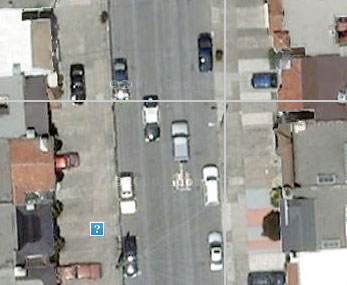
Here’s an overhead view of a slice of the existing 24th Avenue:

(24th Avenue, San Francisco, CA from Google Maps)

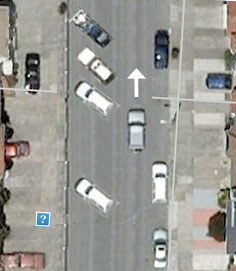
If 24th Avenue was converted to a linear park, 25th and 23rd Avenues would be converted to north and south bound one-way streets respectively. Parking density could be increased to account for lost street parking on 24th Avenue, like this:

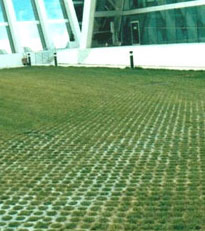
Or, instead you could close off the 24th Avenue “linear park” to through traffic, but still allow parking and access to existing vehicle garages. You can cover the entire 24th Avenue with grass and trees, and pave a smaller space with “grassblocks“, concrete with over 50% of surface as holes for dirt to hold real grass, to allow for local access and limited on-street parking while maintaining a real grass surface.

Grassblock example:

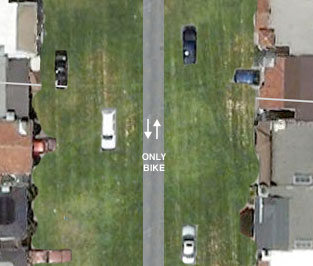
Expanding on this, you could make the linear parks have beautiful bike corridors. Integrating dedicated bike corridors would provide much needed safe, sole-priority biking space.

Linear Park Overhead Example:

(Vehicles are stationary, through traffic would be prohibited and made annoying by bumpy grass concrete.)

This would be very applicable for other City neighborhoods. The Mission comes to mind first: the large area between Mission and Potrero, 16th and Cesar Chavez (Army) is especially starved for green space.

Imagine the effect this would have on quality of life! For many residents, you could step out your door right into a park. For the rest, you could go at most 1.5 blocks to find a large park.

Example of Three Sunset Avenue Arrangements:

(Click for larger version.)

Creating a usable transit system is just the first step. Next, we need to convert our streets back into the livable spaces they once were. We need to take our streets back from the personal vehicle and put them back into the hands of the people.

I imagine your response now, dear reader, “This guy is full of crap. Sure, we all would love a park right in front of our house, but this would never work.” NO! WRONG!

Too many people think this way. They see our City as a dead, unmovable structure. They see personal vehicle priority on our roadways as an absolute GIVEN, and not a CHOICE. The final product is to recreate paradise in our own City. It can be done, it just requires a bit of imagination and some balls to make it happen. These are our streets, let’s take them back.

PS: Related, here are some cool sites about “Parking Day”, converting parking spaces into parks for a day:

Posted in happiness, politics, transit | Tagged , , , , , , , , , , , , , , , , , , , , , , , , , , , , , , , , , , , , , , , , , , , , | 1 Comment

Thank a DPT traffic control officer today.

San Francisco Department Traffic and Parking (DPT) Control Officer

DPT officers get a bad rap. Everyone seems to despise them, yet they are a crucial element necessary to help all of us to effectively share our City streets.

Here are a few of the ways they make our lives better:

  • Parking meter enforcement: You think it’s hard enough to find parking now? Without meter enforcement you would never be able find a place to park in the City’s high demand commercial corridors.
  • Neighborhood permit enforcement: If you work out of town, where do you park your car after work? In your neighborhood. Without neighborhood permitting you would never find a space. Enforcement is key.
  • Transit revenue: Have you ever taken a bus in the City? A great deal of revenue for our public transit system comes from DPT parking fines. This is good.
  • Curbed wheels: It’s not just a joke to squeeze money from you, parked cars without curbed wheels can and do injure people.
  • Sidewalk blocking: Nobody wants to live in a city where anyone can park their car anywhere they please. Blocking sidewalks is rude to most pedestrians and a major challenge for the mobility impaired.

Frankly, most complaints about DPT tickets include silly disclaimers, such as, “I just double parked for just a second… I didn’t feed the meter, but I was just going in for a coffee… I know there was street cleaning, but…” We receive significantly below market cost parking on our City streets. The least people can do is follow simple rules to share our limited parking resources.

So, dear reader, please shake the hand of the next DPT officer you see and say, “Thank you.”

Posted in econ, politics, transit | Tagged , , , , , , , , , , , , , , , , , , , , , , , , , , , , , , | Leave a comment

Driving

  • Sunday was a busy day in the City, Monday was busy enough as usual, but Tuesday early morning was dead. It was very difficult to get orders and I was afraid I would go home with less than $100 take-home — something I haven’t done in a long time. I was preparing myself for a $60 Tuesday.

    But, thanks to some great tipping, I eeked out $115 on Tuesday.

  • I picked up a radio call in the Marina late Tuesday morning. It was a nice midwestern family heading to the airport from one of the many Lombard Street hotels.

    I like families in the cab. The vancabs are great too — plenty of room for their luggage in the back and room to stretch out so the kids don’t start hitting or yelling at each other for violations of the unwritten personal space rules.

    This family was heading back to their Pennsylvanian home after a nice vacation in San Francisco.

    We talked about the City. We talked about the busses — they really liked SF’s Muni system which is, I’ll admit, one of the better systems in the US. We talked about American’s flight to the suburbs and whether or not we’re going to see a flight back downtown. The dad and I had heard and enjoyed the same great Morning Edition stories a month back highlighting these issues.

    We talked about Philadelphia’s downtown resurgence. We talked about life goals, career tracks, the pleasures of not having a boss, my work on a website and past and future travels.

    They were a fun crew. The dad gave me $60 for the $40 fare and I thanked him profusely. That is a very nice tip.

  • I picked up frequently from the St. Francis Hospital at Pine and Hyde, as they use our cab company as their primary taxi vendor.

    I picked up an older lady returning home to the Marina. She was a bit hard of hearing, but that didn’t stop us from chatting about what life was like as a cab driver. She was very frustrated to have had a number of cab drivers that didn’t speak adequate English, at least per her standards. We discussed why this may be the case — for example, potential income from cab driving is decreasing. Keep in mind, income is decreasing not just in real terms (as many jobs do from inflation) but in nominal terms: not only are my dollars earned worth less because of inflation, but I increasingly earn less dollars in the first place because of the increase in gas and gate fees. Unless cab driving pays better, it won’t be able to keep as many native English or native San Franciscans in the profession as they’ll be able to get higher paying jobs elsewhere.

    She tipped me very well – $15 on an $8 fare. She said she wanted to “keep me in business.”

    Thanks lady, you and the airport family went a long way to making my Tuesday income bearable.

  • I am actively working to practice safer driving.

    I picked up a mom and her kid Monday from a swanky North Beach preschool. I took them back to their home across town near Duboce Park. I stopped at the first hint of yellow lights and maintained the average road speed (instead of above average as usual). The difference in reaching our destination would have been 1 or 2 minutes at most. Her tip was as great.

    Clearly, the risk of fast cab driving is not worth the reward. But, it’s still difficult to fight that instinct to go as fast as possible. Dear readers, tip safe-driving cabbies well and complement them verbally on safe driving to encourage this behavior.

  • On breaks and eating during my shift: a lot of friends ask me how I go to the bathroom, where I eat, and how I manage to take breaks.

    Since I only drive 3 shift per week, I try to maximize my driving during those 33 hours. I take brief combined breaks for bathroom and eating.

    I seek out places with clean restrooms, parking and fast food service. In the City where parking is limited, Starbucks, McDonalds and the CalTrain station are shining stars. At each of these places I can park, order, go pee and come out with a small snack and tea or coffee.

    I don’t eat much during the shifts, usually one medium meal (a McDonald’s breakfast) and one snack (a muffin or bagel). I’ll have at most one coffee but lately I’ve been sticking to a black tea or two. I’ll relax and eat a large meal after my shift. It’s a good feeling to pig out after a long day.

  • I picked up a French mother and son pair from their SOMA hotel and took them toward Haight and Ashbury. They weren’t really sure what to see in the City, so we chatted a bit about the Haight and Golden Gate Park.

    Even though my French is laughable, the Frenchies always seem to enjoy my meager efforts. Whether out of pity or graciousness they tip well when I bust out the French. I’ll keep doing so.

  • Most cab companies in the City use a rather old fashioned technology to dispatch call-in orders from customers — a two-way radio.

    For the cab drivers, the radios operate half-duplex. Cab drivers can either listen or receive, but not both at the same time. Dispatchers can send and receive simultaneously.

    As far as I understand, this means there are 2 distinct channels – a high-power broadcast channel from the cab dispatch garage and a second channel used by each cab to broadcast back, usually at a lower-power, to the garage.

    These technological considerations are important as it greatly affects cab dispatch workflow.

    The overall flow and operation of the dispatch radio varies considerably from shift to shift and dispatcher to dispatcher. Dispatching is a complex and challenging task, perhaps akin to the difficulties of being an air traffic control operator with considerably less pay.

    ‘Normal’ operation consists of the dispatcher reading out intersections of calls ‘on the board’, that is, orders called-in (pre-arranged or recently called) waiting to be picked up. “Polk and Green, Lombard and Van Ness, Pine Hyde, St. Marys, 1st and Market, 6th and Brannan van cab.” These are read very quickly and repeated until a cabbie checks in for an order.

    If a driver is in range, he or she will pick up the mic and broadcast back their intersection by saying, “Cab 730 at Bush and Leavenworth.” The dispatcher will respond with, “730 check, and who else?” giving the others a few seconds to check-in for the order as well. The closest driver is given the address, “730, you have 900 Hyde for Susan.”

    Significant complexity is introduced as there is no specifically defined range for an appropriate check-in distance. It requires a learned fine-tuning by cab drivers and dispatchers depending primarily on the number of empty company cabs listening for orders. When the City is very busy, most cabs are full and are not monitoring the radio. The dispatcher’s board fills up quickly with orders and it’s acceptable to check-in within a half mile or so of an order. It is fun and easy to be a cab driver at these times.

    But, in the wee hours of the morning most cabs are empty and no orders are on the board. The instant an order is read aloud there are 10-15 (or more) drivers checking in for the order. Competition is tough — you can be only a few blocks away from an order to have a chance of picking it up.

    I’m most amazed at the effectiveness of this system despite its use of rather antiquated technology. Sure, there are occasional frustrating moments of waiting, such as when a cabbie needs a call-out (if an address is incorrect or nobody answers when after ringing a bell) when the dispatcher is busy assigning other orders. But, the majority of the time the system works well. Often it is just as quick and efficient (or more so) compared to computer-based GPS dispatching systems.

    I also enjoy how the personality of each dispatcher in our company is expressed in their manner of dispatching. Some dispatchers give out orders very quickly. Others want drivers to be much closer to orders. Some are more like robots — repeating orders on the board quickly and monotonously. Others make it more like an auction, complete with an auctioneer’s trademark closing, “Going once, going twice, cab 730 has it.”

    Radio dispatch adds a fun spice in the mix of the already exciting cab driving world.

  • I’m still trying to find the best balance between being openly accepting of whatever comes my way, but still feeling my emotions as I drive the cab.

    I don’t want to let a slow day and low earnings get me down. But, I also don’t want to be completely emotionally disconnected from the outside world’s goings on. It’s a delicate balance to fully feel and recognize my emotions without letting them consume me to direct my mood.

    Perhaps I’m attempting the impossible? I wish to feel sad without feeling sad?

Posted in happiness, taxi, tech, work | Tagged , , , , , , , , , , , , , , , , , , , , , , , , , , , , , , , , , , , , , , , , , , , , , , , | 1 Comment

TV, online video ad buys approach convergence already enjoyed by end-users.

In the world of online buying of offline video ads, Google announced they’ve publicly released their experimental TV ad buying service. TV buying is now integrated with an advertiser’s existing AdWords buying interface, making buying as simple as they did when Google released their revolutionary radio media buying interface.

This is some significant competition for SpotRunner, whose sole purpose is to provide easy-to-use, small scale online TV buying in local markets.

I played with both and noticed one big difference: SpotRunner requires a $1,000 minimum buy, whereas AdWords appears to let you get by at just $150/day. You can get your feet wet with Google’s TV ad buying very, very cheaply. Of course, with both services you’ll still need to create an ad, but these days many savvy small business owners can just whip up something in iMovie.

Meanwhile, in the world of online buying of online video ads, the IAB finally released some up-to-date online video ad guidelines (pdf).

They’re boring to read and surely even more boring to implement, but this is important since finally we’ll have some sort of standardization for fledgling online ad formats like video overlays. I’m a big fan of video overlay ads — a 5-10 second animation on the lower fifth of an online video playback. Overlays combined with a 300×250 companion ad may prove to be a great online video monetization strategy. It punches through the ‘clutter’ of ads — the end-user notices the ad — but it doesn’t get in the way of viewing the desired content. A win, win?

The meta story here is that buying video ads is becoming standardized for online AND offline video content. We can talk all day about the convergence already taking place by end-users watching Lost and the Office on their computers. Now the über-important revenue stream — easy ad buying by the masses — is catching up to the convergence party.

Posted in internets, marketing, media | Tagged , , , , , , , , , , , , , , , , , , , , , , , , , , , , , , , , , , | Leave a comment

Driving highlights

I had a beautiful set of days to drive a cab in the City. Sunny and 60s is the perfect weather. Above 60s and the greenhouse effect of the car windows makes it a bit too warm.

  • I picked up a woman downtown who was heading out toward one of the hospitals in the outer neighborhoods. She was in her 30s with a spunky, outgoing nature.

    We talked about work and the healthcare system. She mentioned she was on disability. A few minutes later she revealed she had been diagnosed with breast cancer. She was in the late stages of treatment and everything was looking good. Her spirits were understandably high.

    She worked in an industry where she could have easily parted ways from a formal employment situation to become an independent contractor and would have made a great deal more money.

    Before her diagnosis she had planned on doing just that: starting her own consultancy, working 60 hour weeks, hiring a few others, making gobs of cash.

    After her ordeal she views things differently. She enjoyed the stability and flexibility offered to her by a formal employment agreement. She enjoyed the low pressure 40hrs/week work life. She enjoys going to work, working, and leaving work at work before coming home.

    I enjoyed her perspective.

  • I picked up a lady from a housing center in the Western Addition. She was heading toward a hospital in one of the neighborhoods. Her husband was in the ICU. The doctors told her he was brain dead, but she was adamantly convinced this was not the case. A few days back she went to see him and said he raised his hand to her presence and in response to prayer.

    What brought him to the hospital in the first place? This was not clear.

    The best I could gather was that he entered the ER bleeding profusely from a gunshot, knife wound, or some sort of other violent altercation. He either assaulted the ER staff outright or did not cooperate and was sedated. She was under the impression that the staff had over-sedated him which caused his current comatose state.

    I had no idea what to take away from all her fervently shared data, but the one indisputable fact was this poor lady was not in a very happy state. I expressed my condolences and wished her the best as we arrived.

  • I picked up a younger woman in the Mission around 5 or 6am Sunday morning. Given the chilly morning breeze, her clothing was nowhere near sufficient and her lady parts were prominently displayed. I took her to meet a man waiting in his car in the heart of the Bayview.
  • Weekday mornings I hunt for street hails and radio fares around my home in Nob Hill in addition to Russian Hill, Pac Heights and the Marina. On one such lap I was cruising on Hyde street and saw two young SFPD officers standing smack dab on the double yellow lines at Jackson.

    A subsequent lap or two later they were still there. I pulled up and pleasantly said, “Hey what’s up? Are you guys looking for something?”

    Keep in mind the social dynamics: I am the same age, gender and race as the officers. So, the important variable under study here is profession to profession relations.

    They both had slicked back hair. One sported name brand sunglasses molded of plastic. The sun shaded officer caustically responded, “We’re looking for traffic violations. Sir, you have a green light.” Nobody was behind me. No other moving cars were, in fact, anywhere near this intersection. Their police vehicle was parked in front of a fire hydrant.

    Wow! What hostility! I was floored. What caused this profoundly negative reaction?

    This isn’t the first time I had such negative interactions with a San Francisco police officer. A few months back I was answering a radio call on the other side of Nob Hill. A police vehicle was behind me as I approached my destination block. I turned on my hazard signals. At this point any City driver instantly knows to pass a cab as it slows to a stop. Instead, this officer stops a foot behind me and starts honking his horn. Yes, he stopped to honk his horn. A few seconds later he passes me and yells, “What’s your problem? You gotta take up the whole road?”

    Oh wait, there’s more. A long while back I picked up a bunch of Canadian guys from a downtown hotel in a vancab. They were going to a 49ers game at Monster Park. After waiting in ridiculous traffic for a half hour, we finally approached the stadium and I asked traffic officers where I should drop the passengers. They directed me forward. When we came to what appeared to be an entrance suitable for my passengers’ needs I stopped, they paid, and I let them out.

    Two officers walked up to me and one started to write me a ticket. Woah there nelly, I said, “What’s going on, officers?” They said, “You’re not allowed to drop here. You’re a dangerous traffic hazard.” This statement was obviously false. I had pulled into a parking spot out of the flow of traffic. I continued with a clear explanation of the process by which I arrived here. “I was directed here by a traffic control officer.”

    “Can’t be. You’re not supposed to drop here.”

    Thank god for my friendly Canadian passengers. The group of six lobbied strong for my safe release, corroborating the tale of a traffic officer gone wrong.

    Wow. There are some major issues here.

    A number of reactions come to mind.

    • Look, I realize that being a cop is often a thankless job. But, come on, so is being a cab driver. Why is there such a prevalent attitude that we’re on different teams, playing against each other?

      Our jobs are very similar. We both cruise the streets for hours on end, judging each and every pedestrian. Yes, our end-goals are different — cab drivers judge pedestrians for likeliness to need a cab, while police officers judge pedestrians for likeliness to be a public nuisance. Regardless, our core activity is similar. At wee hours of the morning there are pretty much only these vehicles on the street: cabs, police cars, trash trucks, and newspaper delivery vehicles.

      Cabbies and police officers serve very complementary tasks.

    • A fleet of taxi vehicles driven by professional drivers roaming your streets 24/7 can provide a significant crime deterrent for your city.

      Most streets would see very little, if any, vehicular traffic in the middle of the night if it were not for cabs crawling for fares. Haight, Polk, O’Farrell, Geary, even Mission. What an amazing crime deterrent cabs are! They are equipped with drivers constantly scanning the streets, with cell phones and cab radios, many have zone-based GPS tracking, all have in-car security cameras.

      Sure, a cabbie isn’t about to get out of his car to break up a fight, but most if not all would be willing to serve their fellow citizens and testify as a witness to a murder.

    • If the City’s mission were to deter crime, they would view cab drivers as an essential component of a crime control strategy.

      Unfortunately, crime prevention is handled by a traditional bureaucratic unit (SFPD), and like all other non-profit bureaucratic units, it serves to forward its own existence.

      How does a bureaucratic unit do this? It silos its function such that only that bureaucratic unit can provide that function. Often this siloing isn’t a real silo (for comparison, water delivery IS a real silo) but is instead gained through evolution of policy and resource control, eventually giving this bureaucratic unit an effective monopoly of this function.

      In no way whatsoever would it be in the interest of the SFPD bureaucratic unit to explore (or even acknowledge the presence of existing) crime prevention duty sharing as this could reduce potential funding to that bureaucratic unit.

      This isn’t a knock on SFPD; this is a knock on non-profit bureaucratic units, of which SFPD is one of a large and esteemed lineage. Muni comes to mind too.

    • Let’s put aside the inherent flaws of non-profit bureaucratic units and attack this from a different angle.

      In my days of higher education student affairs life as a Resident Advisor for the dorms of Indiana University, I experienced an environment that was open and often very emotionally real. (I shall point out that although the IU dorm system was a non-profit bureaucratic unit, it was part of a larger non-profit bureaucratic unit that had profit and loss responsibility — it had to pay for itself.)

      In this HESA environment RAs and residents would talk about real issues they had with each other, their Graduate Supervisors or even full-time staff and even high level managers within the bureaucratic unit. Things were vetted. Issues were addressed. Emotional and real (mission-based) progress occurred.

      Why then, in the ‘real life’ game of taxi and police officers are these issues not addressed? This is silly. It affects everyone from the officers, to the taxi drivers, to the residents of our City. Unlike RA life which lasts at most a year, these issues persist year after year.

      Maybe we could arrange some sort of work exchange program. They can try being a cab driver for a week, and we’ll be cops for a week. (We won’t get guns, but we can write them tickets.)

  • I picked up a “cigarette and candy girl” from a club one morning and took her to her home in the outer Richmond.

    We had a great conversation. She was from the Czech Republic. We talked a lot about the changing Czech identity as they joined the EU. I shared my stories of drinking with Czech women in Scotland who could drink us under the table any day of the week. We shared tales of showing up to banks in the City with fistfuls of cash to deposit in our accounts in order to cut rent checks. What must the tellers think we do? I shared my tale of paying for a dentist visit in $150 cash.

    The City has some neat folks.

  • I picked up a guy from the Castro on a weekday morning and took him to work near Pac Heights. It turned out he was a former limo driver in the City but was still involved heavily in the business. We talked a lot about the gas prices, taxi gate fee increase, and impending doom coming this winter.

    I learned some useful things: he claimed limo/black cab drivers aim to make about the same as cab drivers. In fact, he said most driving jobs in the City approach $150 for 10-hour shifts.

    As gas prices continue to rise, this cost will be squeezed at all levels, from the owners, drivers and end-users.

  • I picked up another limo driver the next morning. He had run out of gas. He was a character. We drove to his girlfriend’s Academy of Art dorm to pick up some cash, headed to a gas station to buy a canister and some fuel, and then back to his limo.

    He said that with my City knowledge I would be able to make a bunch more money driving a limo than a cab.

    “How would I get fares?” I naively asked.

    “Oh, you know, the same way you do now. You know way ahead of time if someone will hail.” (This is true.) “You just approach them and make a deal.” Okay, wow. “Of course, the best part is that you don’t have to pay gate anymore.”

    Hmm. I think I’ll stick with paying extra for a legal cab. But, thanks for the info.

  • My therapist really likes my job. Not that she wants to do it, but she likes it for me.

    She’s really intrigued by the role I play in other people’s lives. (As am I.) Do I serve as a form of therapy for others? Often, yes. Often, no.

    If people really need someone to talk to, they make that very clear, and I am there. We talk. I do an okay job pulling out their fears, sadness, anger, excitement, joy, or whatever may be lurking underneath the surface. I like that. It’s very real.

  • I consistently make the erroneous assumption that all other cab drivers are ‘lifers’, having always been and always will be a cab driver.

    Of course, this is not true. This is most clearly brought to my attention when I pick up or drop off other cab drivers from my company heading to or from work. It is fun to see who they are, why they drive a cab, and what they do with their non-cab driving time.

    Our City is blessed to have such a dynamic and diverse taxi workforce.

  • While driving Tuesday morning, I heard a great segment on KQED’s forum about Buddhism. The whole thing is worth a listen; the first 15-20 minutes are the most juicy.

    My takeaway: it is important to feel and recognize your emotions, but not let them control you. Use the energy toward a productive output.

    This is clearly represented with my cab driving. From poorly timed red lights, to grumpy customers, angry cops, dangerous drivers, low earnings, graveyard shifts, poor tippers, and crazy coworkers stealing orders, I can create an endless list of potential negative influences to bring me down, angry and frustrated. The only thing I can really control is myself and my reaction to these influences.

    Lest you be worried, most of the time the positives significantly outweigh the negatives. Life is good.

Posted in happiness, politics, taxi, work | Tagged , , , , , , , , , , , , , , , , , , , , , , , , , , , , , , , , , , , , , , , | Leave a comment

You’re richer than you think.

Money bag and piggy bank

While sitting in the queue to pay the toll for the Bay Bridge Monday, I heard two great counterintuitive pieces on KQED.

The first was a thoughtful comparison between our quality of life now compared to the distant past. It is a true and important comparison and a nice reminder of how great our lives really are in modern times.

“A Very Rich Man” KQED Perspective:

The second was a nice piece by NPR’s Morning Edition which sought to answer the question of why Americans have built up so much personal debt in the past 20 years. I liked this part: for some, debt it good. Debt is not always an evil thing.

In my case, I know that my income will be considerably higher in a few years than it is now. As exemplified by the example in the story, it would make little sense for me to save money now given my limited income.

“Why Do We Borrow So Much?” Morning Edition Story:

Posted in econ, happiness | Tagged , , , , , , , , , , , , , , , , , , , , , , , , , , , , , , , , , , | 2 Comments