Cab driving: earnings update

Time for an earnings update.
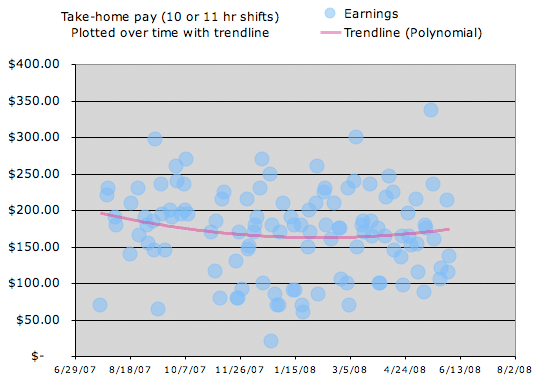
My earnings floor — the lowest take-home pay I can expect — is increasing from the record lows of the winter. In other words, it’s rare this time of year to see a shift that doesn’t net me at least $100. In the winter I had sub $100 shifts much more often.

The ceiling seems to hover around $250, with occasional exceptions like Bay to Breakers Sunday — the most recent high outlier on the chart.

Unfortunately, earnings don’t ‘feel’ as high as they did last summer. Indeed, recent earnings seem clustered around $150, compared to a large cluster around $200 last summer. Two obvious reasons: gate fee increase and fuel cost increases, both costs are borne directly by cab drivers. Other potential reasons: tourist activity has yet to reach peak, major SF events and street fairs happen later in summer, I work less lucrative shifts than last summer.

For fun, here is a chart of gas prices over the past year. The red line is San Francisco, the blue is USA average.
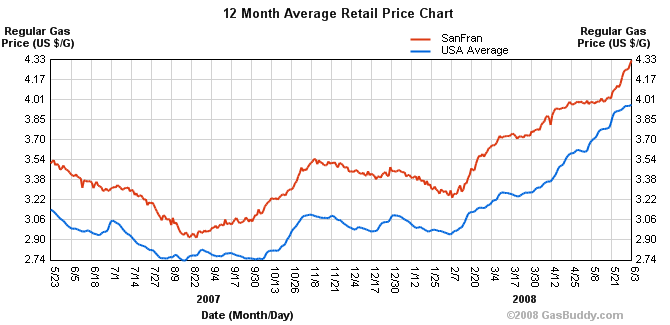
Chart of gas prices over one year in San Francisco and USA

My take-home shift average still hovers around $170.10* since I started driving July 2007. My median take-home pay (the middle amount of all shifts worked) is $176.

When I started last summer it was at the peak of the high earnings season. Plus, I worked the rather lucrative Saturday and Sunday day shifts (when compared to lower earning Monday and Tuesday shifts I added). I thought these seasonal and day of the week changes would give an artificially inflated view of my earnings, so I also computed take-home average for 2008 only, which starts at the low-point of the season and includes the lower earning Monday and Tuesdays.

I guessed the 2008 year-to-date (YTD) average and median take-home would be significantly less, but I was surprised at the outcome. 2008 YTD average is $168.54 and 2008 YTD median is $170. Both figures are surprisingly close to my all-time average.

*I do not subtract money spent on food during my shifts. This is important so that my variable food spending (which can range from $0 to $20 during a shift) doesn’t affect the outcome and so that I don’t have an odd monetary incentive to not eat (in order to inflate my take-home pay statistics). But, the reality for most drivers is that ‘food costs’ are a real expense, subtracted from take-home cash pay. So, any other cab drivers reading this, be sure to add back in your food costs to compare your earnings to mine.
Posted in econ, taxi, work | Tagged , , , , , , , , , , , , , , , , , , , , , , , , , , , , , , , , , , , | 3 Comments

Media roundup: sci fi, electronica, the tragedy of suburbia, and public radio

And now, a brief list of things produced by fellow humans I enjoyed reading, hearing and watching in the past few weeks.

Books:

  • Larry Niven’s Ringworld

    I was drawn in by the concept of a ringed artificial habitable structure orbiting a star — one of the inspirations for the Halo universe. I was pleasantly surprised to find not only did Niven deeply expand upon the technical considerations of such a structure, he managed to weave a captivating story alongside. Niven has an odd, matter of fact writing style but his unique alien characters clearly punched through his plain style.

  • Orson Scott Card’s Speaker for the Dead, his sequel to Ender’s Game

    I was pleasantly surprised with Speaker. It took an abrupt turn from Ender’s Game, which was primarily a space-war novel. Speaker is a philosophical anthropological ‘what if’ tale — what if humans colonized a planet with an existing sentient species. I found it very rewarding.

Music:

Online:

  • Reddit.com – best described as “the new Digg.”

    Like Digg, Reddit accepts submissions of web links. But, unlike Digg, clicking on a link in Reddit doesn’t lead to the ‘link metadata page’ before actually bringing you to the external site — it just links to the external site. Reddit encourages you to read the ‘link metadata page’ by way of its perfectly threaded and moderated comments. This encourages thoughtful and complete discussion, whether the external link in question is a silly picture of a dog or a depressing world affairs story.

    I enjoy the discussions, but I recognize a significant bias toward libertarian viewpoints. (Ron Paul has an unusually high share of voice on the site. Frequent posts argue for returning to the gold standard.)

  • James Howard Kunstler speaks about the tragedy of suburbia. I feel similar emotions as he expresses, but never have I felt comfortable expressing it publicly in such a way. Watching his speech is a pleasure as he strongly emphasizes our nation’s real tragedy: poor city planning.

    Choice quote, “…When you think about those young men and women who are over in places like Iraq, spilling their blood in the sand, and ask yourself, ‘What is their last thought of home?’ I hope it’s not the curb-cut between the Chuck-E-Cheese and the Target store, cause that’s not good enough for Americans to be spilling their blood…

Radio:

  • Selected Shorts – Odd Couples. I loved the first story of this program, Aimee Bender’s “The Meeting.” It starts around 7 min, 30 seconds. (MP3 Link)
  • Fareed Zakaria on KQED’s Forum speaks about post-Americanism — what is America’s world role now that it’s waning as a super-power? I was also inspired by Mr. Zakaria’s array of statistics pointing toward the positive direction, a nice break from news stories I usually see in the media about the falling of the sky.
Posted in internets, media | Tagged , , , , , , , , , , , , , , , , , , , , , , , , , , , , , , , , , , , , | Leave a comment

Station Manager of 91.7 KALW San Francisco reaches out to listeners.

During my Tuesday shift I was pleasantly surprised to hear a radio station manager speaking directly to listeners for an extended period of time about the state of the station. In the past, I’ve heard station managers speak during pledge drives, but pledge drives offer a relatively small subject of conversation when compared to an open-ended manager report.

KALW’s Manager’s Report took place in the late morning, preempting an episode of a local call-in forum show.

Similar to Indiana University‘s arrangement with public radio station WFIU, the San Francisco Unified School District provides KALW with discounted real estate and other ancillary business support services such as telco, Internet access, payroll processing, basic utilities, etc. But, they must find revenue sources to pay for staff, production costs, and purchase programming from NPR and other sources.

I enjoy 91.7 KALW’s positioning as an ‘alternative’ public radio station — an antithesis to the standard NPR fare of 88.5 KQED.

Of course, as a public radio junky, I also enjoy KQED’s great standard NPR program offerings, but KALW provides a nice alternative view with a heavier focus on world news, especially BBC programs like World Have Your Say and the BBC World Service through the wee hours of the night. KALW is also my source on Sunday morning for unique radio programs like Working with Marty Nemko and Harry Shearer’s Le Show.

Keep up the good work, KALW!

MP3 direct link to KALW Manager’s Report

Posted in media | Tagged , , , , , , , , , , , , , , , , , , , , , , , , , , , , | Leave a comment

Muni strikes again.

I wouldn’t be doing my Civic Duty if I didn’t link to yet another Municide.

This time the culprit was an articulated standard coach (non-trolleybus) 71-Haight/Noriega heading inbound on Market at 6th. A 77 year old female pedestrian was struck and later died at SF General.

6th and Market is a zoo of an intersection at best, made worse by Tenderloin-style pedestrians who seem to get personal satisfaction by running in front of traffic.

However, at this point in the route, the 71-Haight/Noriega has a purely straight trajectory — a path easy for both the driver and daredevil pedestrians to anticipate. Thanks to the mid-lane bus-stop islands the busses don’t even have to pull into a standard Muni bus stop. Given this simple trajectory, this vehicle should not have been turning, leaving little obvious clues as to how it managed to smush the elderly lady.

More data would be nice to enable the community to put pressure on Muni to prevent further similar incidents. Unfortunately, more data we will not have.

Link

Posted in transit | Tagged , , , , , , , , , , , , , , , , , , , , , , , , , , , , | Leave a comment

Working Memorial Day

I started 3am Memorial Day Monday. It was more like a Sunday than a Monday, with plenty of people still partying the night away.

A friend sent me a tip that there was a big after party around 6th and Folsom. This, along with many other SOMA hotspots, was a major source for fares.

  • I picked up 3 gay guys from the exodus of an underground party closing near 1st and Howard. They were heading back to one of the guy’s place to have sex and were very open about it. They seemed very excited and discussed some various related logistics such as bed size, supplies of prophylactics, and privacy from roommates.
  • I picked up a group of young Asian partiers from one of these parties. They weren’t so drunk, they were more high and out of it. They talked about the effects of their respective pills. They said the party was really boring until they took the pills.
  • I picked up a gay male couple who were super-hungry after dancing all night. They wanted to know where was closest to eat near Union Square, we headed for Denny’s on Mission just a few blocks away. I wanted some Denny’s too.
  • Memorial day morning became considerably quiet after 6am. Not many people were in the City, and those that were didn’t seem to leave their apartments.
  • Tuesday was busy, nearer to a Monday’s level of activity instead of a normally slow Tuesday.
  • Early Tuesday morning I did a few runs in the Mission before heading up to Pac/Marina/Nob/Russian Hills-land. Usually the Mission isn’t too bad, but I did 2 prostitute runs in a row which was a bit unusual:
    • I picked up two middle aged Mexican guys and an older black lady around 24th and Mission. I took them to a seedy hotel in the far outer Excelsior.
    • I picked up a younger Mexican guy and a younger black lady also around 24th and Mission and took them back to the guy’s place in the Excelsior. The lady was talking the entire time on her cell phone to her boyfriend or a close male friend.
    • You may ask me, “How did you know these were prostitute runs?” I don’t know for sure, but context clues pointed strongly in this direction.

      I felt a little dirty about it, but also felt that if I didn’t take them, someone else would take them, what would me not taking them change about their transaction? Nothing. I would just miss out on a few fares during the quietest time of night.

  • I picked up an older i-banker sort of guy from the Marina and took him to the Financial district. After he jumped in, I accelerated hard up Gough and he asked, “Are you rushin’?”

    “Yeah,” I answered back, “But, I rush pretty much most of the day. It’s just a habit.”

    “No,” he said, “Are you Russian?”

    I laughed, “Well, actually, yeah my Mom’s side is Russian.”

    His question is one of many variants of the core question, which is, more directly, “What is your background such that a young caucasian driver is driving this taxi?”

    Other forms of the question include but are not limited to, “Are you in school?” “You don’t drive full time, do you?” “What are you doing besides driving a cab?” “How long [have you been]/[will you be] driving a cab?” “What made you want to drive a cab?”

  • Another Tuesday passenger asked me if I was Jewish. I said, “My mom was raised Jewish, so I guess that means yes.”
  • I picked up a lady I had driven before (first story of this post). She was just as chatty as I had remembered and we had a great time again.

    She was heading back from a doctor appointment to get her teeth at her apartment, then heading to the bank. I asked her where she was heading, she opened her mouth and said, “To get my teeth!” keeping her mouth open after she said this. I laughed and she cackled a hilarious laugh which said, “I’m doing my best to freak you out, but you’re a good sport.”

    She had a lot of spunk. She tipped well and we shared stories of family. I told her about my recent visit back home to Indiana to visit my family. I’m looking forward to picking her up again soon.

  • I picked up two girls from Cal Train and took them to a City bus tour departing from the Fish Wharf. They were very quiet, but I got out of them that they hadn’t ever visited the City. So, I took it upon myself as my Civic Duty to tell them a bit about our path as we wound through the Financial district, by Chinatown, through North Beach to the Wharf. I thought they might have been annoyed, but they gave me a big tip ($15 on a $9 fare) in the end.

    It seems that erring toward speaking too much trumps speaking too little in the effort to maximize tips.

Posted in taxi, work | Tagged , , , , , , , , , , , , , , , , , , , , , , , , , | Leave a comment

Examiner print daily is heaven, Examiner online is hell. Why?

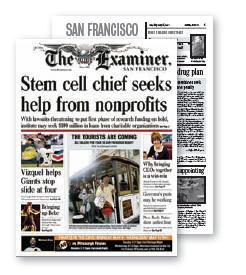
The current iteration of the San Francisco Examiner — the free, tabloid-sized print daily focused primarily on San Francisco news and events — is top notch. It’s a quick read, conveniently sized and simple but effective in delivering a local news update.

Here’s a sample:

Sure, the Examiner won’t win any awards for ground breaking investigative journalism, but it delivers a simple product effectively.

The success of the Examiner print makes it even more of a shame that their online version sucks so much. The online headline often differs completely from the print version — which I view as a major fault. The print version provides consistently intriguing headlines, like “Mayor steals money from Muni,” that draw your attention to pick up the paper. Why don’t they match? The only reason I’ve ever thought to go to Examiner’s online page is to read the full story when I walked by a paper on the ground with an enticing headline. Duh?

The “top stories” on Examiner’s web page link to other sources. This doesn’t make any sense to me. As of writing this post, the second top story is a link to an SF Gate story about setting a new record for handshaking. Yes, a new record for handshaking. This isn’t a “top story” in real life, nor is it a “top story” in the print Examiner daily, nor did an Examiner writer write this story, nor does clicking this link earn revenue for the Examiner. So, why include it?

The Examiner online team is asleep at the wheel. (Perhaps there is no Examiner online team.) Too bad considering the print daily is spot on.

Posted in internets, media | Tagged , , , , , , , , , , , , , , , , , , , , , , , | 2 Comments

June 3 voting guide: No on 98, 99, F. Yes on G.

All these propositions are really annoying. I’ve received over 15 mailers for and against state and local measures and candidates. 15 * millions of Californians is a lot of waste.

I really enjoyed SPUR’s voter guide.

Or, ignore it all and just follow these tips:
No on 98 AND no on 99. No on F and yes on G. I don’t care about the rest though surely they’re important to worry about for some reason.

Posted in politics | Tagged , , , , , , , , , , , , , , | Leave a comment

Robots are better at space exploration than humans.

As many close friends can attest, I dream of the future human colonization of planets in our solar system and beyond. Ah, how I stew in the romance of this idea.

After doing some math prompted by lively debate on the BBC’s forum radio show “World Have Your Say”, I fear I must let go of this dream, or at least that this dream will take place during my lifetime.

It is simply too cost prohibitive to send humans as our primary explorers. Robots can do as much, or more, at a fraction of the cost. (Perhaps humans could be the next ‘wave’ of Mars visitors.)

The juxtaposition of two recent news stories serves as a stark reminder of the difference between man and machine’s space exploration abilities: while the Phoenix lander paves new ground in the exploration of the Red Planet, the International Space Station toilet breaks, forcing its human occupants to poop in bags.

Humans are fickle organic creatures with exceedingly precise operational conditions (from the maintenance of proper temperatures to providing constant breathing air, food intake and waste disposal). The cost of maintaining these human operational conditions are astronomical compared to sending a lone machine. The International Space Station cost $157 billion since project inception. This individual Phoenix lander cost $420 million.

Yes, these projects accomplish different goals with different timelines and cannot be directly compared. But, the stark difference between cost and output — we could have sent 373 Phoenix landers for one space station — is indisputable.

Robots for the win!

Posted in econ, tech | Tagged , , , , , , , , , , , , , , , , , , , , , , , , , , | Leave a comment

I propose a new online ad metric: seconds per impression

Online ad sales reps enjoy using the term “engagement” in their sales pitches. “OurSite.com’s users are highly engaged with our content, and so shall they be with your ads!”

What does “engagement” really mean? Some part is puffery — it’s an abstract term. Anyone can claim they have engaging content, but it’s hard to measure. But, despite my deep rooted discontentment with ad sales pitches, “engagement” does attempt to define a real need from media buyers: I want my ads in placements that demand attention from the end-user.

What if there were a way to objectively measure engagement? Here’s a simple suggestion: measure the average number of seconds displayed per impression (SPI) for a given placement. You could backdoor a site-wide SPI estimate from existing analytics data by taking ‘average length per user session’ divided by ‘average page views per session’ and expressing this in seconds/page view units. (Both session length and page views per session data are available in common analytics packages.)

SPI stats could be available for one specific placement on a particular page of a site and also aggregated site-wide to give an overall average SPI for an entire web property.

What would this do? It would provide a quick and easy measurement to validate placement bids expressed in CPM (cost per thousand impression) when comparing against other sites of a potential buy. You could even derive a cost per thousand seconds (CPMS = CPM / SPI). By using CPMS or CPM and SPI in tandem, you would get a uniquely different tool to help compare the potential value of sites competing for a buy.

Let’s say MySpace.com offers a $3 CPM for run of network ads (run of network = non-section specific, anywhere they have free space), whereas NYTimes.com offers $10 CPM for run of network. Inventing some numbers from intuition, let’s say that MySpace users spend 5 seconds per page (5 SPI) whereas NYTimes.com users have an average of 15 SPI.

NYTimes CPMS @ 15 SPI = CPM / SPI = $10 CPM / 15 SPI = $0.67 CPMS (Cost per thousand seconds)
MySpace CPMS @ 5 SPI = CPM / SPI = $3 CPM / 5 SPI = $0.6 CPMS (Cost per thousand seconds)

Wow, these numbers seem about right. We approach a $0.6 cost per thousand seconds of user-engagement for both sites, with a slight premium placed on NYTimes.com from higher quality content. In fact, when considering CPMS instead of CPM, NYTimes.com seems like a bargain: it’s just a shave more expensive than MySpace when calculated in CPMS, but its content is unquestionably a more premium placement for most brands than MySpace.

This metric has neat implications for the monetization potential of social networks vs. online video. You might disagree with my 5 SPI for MySpace, but I contend that it will not exceed 10 SPI. Compare that to YouTube, which could have a site-wide average of 60 SPI (videos can range up to 10 minutes — 600 SPI!). Let’s say YouTube prices at $10 CPM (run) (note: it’s surely cheaper than $10) whereas MySpace is still $3 CPM (run).

MySpace CPMS @ 10 SPI = CPM / SPI = $3 CPM / 10 SPI = $0.3 CPMS (Cost per thousand seconds)
YouTube CPMS @ 60 SPI = CPM / SPI = $10 CPM / 60 SPI = $0.17 CPMS (Cost per thousand seconds)

Obviously, YouTube blows MySpace out of the water. (Of course, other performance metrics should help with planning media buys too too – historical CTR, APM, CPA, etc. This would be a nice standard addition to the media planning toolbox.)

Epilogue:
“Oh no!” A social network ad salesman frets upon reading this post, “When calculated with CPMS it is now embarrassingly obvious that social networks are a bad buy for most display advertising! What ever am I to do?”

Not to worry, social network ad salesman, most clients and agencies don’t give a shit about this stuff, they just want to see their pretty ads on the pretty computer screen.

So, keep using the old ‘engagement’ pitch with the wide-eyed recent college grads munching away at free Starbucks muffins in conference rooms of their conglomerate parents, and they’ll keep throwing tens of thousands of dollars your way.

Posted in marketing, media | Tagged , , , , , , , , , , , , , , , , , , , , , , , , , , , , , , | 4 Comments

More Bay to Breakers

  • This is a continuation of a previous post.
  • Toward the end of my shift, around 3pm, I picked up an elderly Chinese couple hailing on the street downtown. They were heading all the way out to the deep Richmond on the far west side of the City. We took Turk as far west as we could go until it turns into Balboa. They lived on Balboa so we continued on as both Fulton and Geary were clogged from the post-race exodus.

    Being the transportation geek I am, I put a lot of thought toward transportation logistics, especially after the event. Wikipedia says Bay to Breakers brings in close to 100,000 participants each year.

    As I drove westward with the elderly Chinese couple it became quickly apparent that there were insufficient transportation options available for people leaving the event. Starting from about Divisadero westward there were hails at every block. From Park Presidio westward there were constant hails on both sides of the street from a thick crowd of tired, drunk and shivering partiers who hadn’t dressed for the chilly afternoon fog.

    The problem is two fold:
    1) There was insufficient transportation infrastructure to bring these folks back downtown, and
    2) Race participants from out of town were clearly unaware of the meager transportation infrastructure that DID exist, namely the frequent but slow 38-Geary just 2 blocks north of Balboa.

    I noticed a number of special Muni “Bay to Breakers” busses which, according to SFMTA’s website, provided express service from GG park direct downtown. This is well intentioned, but a bit silly. Both the N-Judah and 38-Geary provide regular, high-capacity service downtown. Providing parallel express busses is inefficient use of resources. As evidenced by street hails and my brief glimpses of the few busses they used for the “special” service, the special busses did not offer nearly enough capacity.

    Here’s a better solution: provide FREE shuttle busses from the event to the 38-Geary and N-Judah lines, and beef up the frequency of these lines. Use the special event fare to pay for additional 38-Geary and N-Judah runs. Again, it was silly to reinvent what already exists — adequate eastbound transit lines are in abundance in the Sunset and Richmond. The only missing piece of the puzzle were north/south bound shuttles from the park to the 38/N lines with clear signage directing pedestrians toward these shuttles.

  • During both the pre-race rush and the post-race exodus I received a number of calls from friends looking for cab rides.

    This is a tough request to balance: On the one hand I seek to earn as much as possible during my shift while I have access to the limited resource of a cab operating medallion and the vehicle, but on the other hand I want to help out friends who are having a hard time catching a cab, especially given the unusually high demand for cabs in the City. Balancing those desires is difficult.

    The best balance I have come up with is to offer a ride if I’m in the neighborhood. Here is the best reasoning I can muster:

    • The only time that these requests are made is when the City is extremely alive: demand for cabs is high which is usually correlated with traffic congestion. Thus, traveling to another ‘zone’ will cost at least 1, perhaps 2 fares since travel time is compounded by congestion.
    • By the time I finally move to the new zone, especially one far across the city, most likely that person would have been able to find a cab had they not been waiting for me. Or, in the worst case, they did find a cab and my effort is wasted.
    • Because the person is either a close friend or a friend of a good friend, I will charge them nothing, less than the meter, or, at the least, I won’t accept a tip. It’s a bit counterintuitive to recognize that the cost is not just the actual ride I gave them for free, but also the time required to change zones. Therefore the total cost could be as many as 2 or 3 fares, not just the 1 fare that I gave them for free. (2-3 fares is $15 – $45.)
    • The best compromise I can offer is to pick a friend up if I’m in the same zone, which is just a 1 fare cost assuming they aren’t charged.
  • After dropping the elderly Chinese couple in the deep Richmond, I knew I could easily find a fare on Balboa. But, as sometimes happens in times of extreme cab demand, I was a bit apprehensive about re-approaching the masses of humans hailing their hearts out.

    It’s a scene out of a classic zombie film: You’re the last human alive on Earth. As you drive through the urban wasteland, masses of brain-dead zombies try to attack your car, tearing at the loose rubber seams of your cab’s door jams with an unending murderous zeal to taste even a sliver of your as yet untainted human blood. This is what Balboa Street at 39th Avenue looked like Sunday afternoon after Bay to Breakers, at least in the eyes of this cab driver.

    I went a few blocks on hail-free Anza, making the plunge to Balboa-land around 37th Avenue. Every corner of 37th and Balboa bulged with ravenous taxi-hungry yuppies. One of the groups had a camera — a very expensive commercial grade TV camera. I aimed for them — chances are they wouldn’t be too drunk or ravenous. It turned out to be a crew shooting for an HD Net travel program. As they climbed in the 7 passenger van, a smaller group approached our cab to squeeze in and share the journey back downtown. “Can we come along too?” I deferred to the first group, “I have no problem with it, but I’ll defer to the first party and we’ll drop them off first.” We had a deal.

    The HD Net crew was heading back to their Fisherman’s Wharf hotel. To avoid as much traffic as possible I headed north on Park Presidio and swung around the Marina to the Fish Wharf. It was a great route. We chatted a bit about HD video equipment’s astronomical pricing. Their camera, without a lens, cost upwards of $40,000 — add $30,000 for a lens and you’re now carrying around a piece of equipment worth the value of a factory built house and lot in the super-suburbs of Indianapolis. We talked a bit about HD formats; there are still a number of tape-based formats battling for victory, but it appears that fight will be short-lived as the battles moves toward tapeless. I was intrigued; our additional passengers were not.

    The HD Net guys tipped me very, very well, handing me two twenties for a $18 fare. I did a good job aiming for potential passengers. I took the 3 remaining friends downtown to Union Square and charged them only the meter of the remaining distance. All parties were happy with the transaction. Including the elderly couple, I netted $80 from a quick out/in Richmond run. I look forward to future City event days. Pride weekend is coming up soon.

  • Just as I thought about the breakdown of the City’s overall transportation infrastructure to bring race goers home from the event, I thought specifically toward the breakdown of the cab infrastructure.

    Obviously, there is not sufficient supply given the outlandishly abnormal increase in demand. I am a big fan of the concept of peak medallions, or supplying a peak increase in supply at times of obvious demand increases. Another approach is to fiddle with pricing.

    I imagined one such approach: let’s say that people could call my cab company during times when it’s impossible to find cabs. On Sunday, during the B2B event, it was tough to get through at all, and even if the call was answered there just weren’t enough cabs to answer the flood of incoming requests. Most of the radio calls that were answered were airport runs (I answered a few on Sunday). Why are those responded to when others aren’t? The obvious answer is that airport runs net the driver a lot of cash for the amount of time invested.

    So, airport runs attract drivers even on a busy shift because it offers a higher than average (guaranteed) payoff. Why couldn’t this work for extremely urgent intra-City runs?

    Driving down a street with hails at every corner doesn’t give me any information, aside from instant surface judgments, about the degree to which each person really needs a cab. Instead of trying to guess which waiting customer really needs a cab, a simple method would be to increase the price of cabs, or offer the chance for customers to make clear if they are willing to pay more. Customers could call dispatch and be clear that they are comfortable paying double meter. Drivers would be more willing to pass up street hails to answer double meter dispatch calls.

  • I took a New York family from a restaurant to their son’s USF graduation at the top of Nob Hill at the Masonic Center.

    The dad and I talked on the ride about why it was so tough to find a cab, why the City’s cab fleet has a hard time expanding to peak demand, how NYC has a power of ten more cabs (15,000 vs. 1,500), how a peak medallion system would be difficult to implement but would be labor friendly, and how indecision to act on a solution hurts residents and visitors of the City.

    As I dropped them off he said, “You’ll do well.”

    “Today?” I asked. “It’s been a good day given all the City events.”

    “No, you’ll do well in the rest of your life.”

    Thanks for the compliment, NYC dad.

Posted in taxi, work | Tagged , , , , , , , , , , , , , , , , , , , , , , , , , , , , | 1 Comment